Free shipping on orders over $100 (AU)

Australia Beads

How to Choose the Right Stringing Material for Your Jewellery Project
Stringing Material Guide

Jewellery Making Guides  ·  Stringing & Materials

How to Choose the Right Stringing Material for Your Jewellery Project

The wire, cord or thread you choose is just as important as the beads themselves. Get it wrong and even the most beautiful design will fail. Get it right and your piece will last for years.

By Shama Rashid

Australia Beads  ·  Est. 1998, Greenvale VIC

If you have spent any time browsing a bead store — online or in person — you will have noticed that the stringing materials section is often just as overwhelming as the beads themselves. Beading wire, nylon thread, tigertail, elastic, leather cord, waxed cotton, hemp — the options seem endless, and the packaging rarely tells you what you actually need to know.

After 27 years of selling beads and supplies to makers across Australia, I can tell you that the single most common cause of a broken bracelet or a necklace that simply does not drape correctly is not the bead choice — it is the stringing material. Choosing the right one is not complicated once you understand a few fundamentals, and that is exactly what this guide is here to do.

We will work through the main stringing materials available, what each one is genuinely suited to, and — importantly — what each one is not suited to. No filler, no fluff. Just the practical knowledge you need before you buy.

1. Beading Wire (Nylon-Coated Stainless Steel)

Beading wire — sometimes called tigertail, though that term technically refers to an older, inferior version — is the workhorse of contemporary jewellery making. It consists of multiple strands of ultra-fine stainless steel wire twisted together and coated in nylon. The result is a flexible, durable stringing material that holds its shape under tension and resists kinking far better than older single-strand wire.

The number of strands matters enormously. A 7-strand wire is stiffer and more economical, suited to chunky statement pieces where drape is not a priority. A 19-strand wire is noticeably more supple. A 49-strand wire, at the premium end, drapes almost like fabric and is the right choice for delicate seed bead work or any design where fluid movement is part of the aesthetic.

Wire diameter: the number that actually matters

Beading wire is measured in either millimetres or fractions of an inch. For most beads with a standard drill hole, 0.38mm to 0.46mm (roughly .015"–.018") is the versatile range. Go up to 0.5mm or 0.6mm for heavy stone beads or large-hole beads. Drop down to 0.28mm–0.33mm for fine seed beads and delicas where a thicker wire won't even pass through the hole.

Beading wire is finished with crimp beads or crimp tubes — small metal cylinders that you flatten with crimping pliers to lock the wire in place at each end. Never tie beading wire in a knot; it will weaken the wire at the stress point and the piece will eventually fail there.

Best for: necklaces, bracelets, anklets, and any design using heavier stone beads, glass beads, or metal beads. Also the correct choice for any piece that needs to withstand daily wear without re-stringing.

2. Nylon Beading Thread

Nylon thread — sold under brand names like Nymo, C-Lon, and FireLine — is the material of choice for off-loom bead weaving and seed bead work. It is thin enough to pass through the tiny holes of size 15/0 seed beads multiple times, which is often exactly what bead weaving techniques require. It is also available in a wide range of colours, which matters when the thread will be partially visible in the finished piece.

Nylon thread has some stretch, which can be an advantage in woven pieces because it gives the work a slight give without pulling apart. However, this same characteristic makes it unsuitable for strung jewellery where you want the piece to hold its shape on a string — it will stretch under the weight of beads and the necklace will elongate over time.

FireLine, which is technically a thermally bonded gel-spun polyethylene rather than traditional nylon, is notably stronger and has less stretch. It has become the preferred choice for many beaders working with sharp-edged beads like Swarovski crystals, which can cut through softer threads over time.

Best for: bead weaving (peyote, brick stitch, herringbone, RAW), bead embroidery, loom work, and any technique using size 6/0 seed beads or smaller.

3. Elastic Cord

Elastic cord is the most forgiving of all stringing materials and, for that reason, it is often the first material new beaders reach for. Stretch bracelets are genuinely quick to make — no clasps, no crimping — and they work for a wide range of wrist sizes without adjustment. That is the good news.

The honest truth is that elastic cord has a finite lifespan. The elasticity degrades with wear, particularly with exposure to perfume, body oils, chlorine in pools, and UV light. A stretch bracelet made well will typically last one to three years with regular wear before it needs re-stringing. This is worth communicating to customers if you sell your work.

Elastic cord quality varies enormously. The thin, semi-transparent elastic sold in craft shops is the weakest option. Look instead for round elastic cord in 0.7mm or 1mm diameter — the round profile grips beads more securely and the thicker gauge holds more tension. Tie with a surgeon's knot (not a standard overhand knot), add a drop of jewellery glue, and trim the ends cleanly.

Elastic cord and bead hole size

Always check the drill hole diameter of your beads before buying elastic cord. Many gemstone beads and some glass beads have narrower holes than you might expect. A 0.7mm cord will not pass through a 0.5mm hole — and forcing it will fray the cord and weaken your knot. When in doubt, buy 0.5mm elastic and double-strand it for added strength.

Best for: stretch bracelets, children's jewellery, quick gifts, beginners learning to string. Not recommended for necklaces, where the weight of beads accelerates elastic degradation.

4. Waxed Cotton Cord

Waxed cotton cord has a warm, natural quality that synthetic materials simply cannot replicate. The wax coating makes the cord slightly stiffer than unwaxed cotton, which helps it pass through bead holes more easily and ties into clean, firm knots. It is available in a wide range of diameters and an extensive colour palette.

The most traditional use of waxed cotton in jewellery is knotted between beads — a technique used for pearl necklaces and high-value gemstone strands. Knotting between each bead serves two purposes: it protects the beads from rubbing against each other and wearing down the drill holes, and it means that if the string breaks, you lose at most one bead rather than the entire necklace scattering across the floor.

Waxed cotton is not, however, particularly durable in terms of long-term wear. It is susceptible to moisture and will soften and weaken if worn in the shower or swimming. For pieces intended for daily wear, it is worth considering whether waxed cotton is the right choice or whether nylon-coated wire would serve the wearer better.

Best for: knotted pearl and gemstone necklaces, macramé-style designs, bohemian and natural aesthetic pieces, sliding knot bracelets.

5. Hemp Cord

Hemp cord is the traditional material for macramé jewellery and has experienced a genuine revival alongside the broader trend toward natural, sustainable materials. It has a distinctly organic texture and works beautifully with earthy beads — bone, wood, ceramic, and certain gemstones — where a synthetic cord would look incongruous.

Hemp is not a precision material. Its texture and slight irregularity are part of its appeal. It knots easily and holds knots well without slipping, which makes it ideal for square knot and half-hitch macramé techniques. The natural fibre does respond to moisture — it swells slightly when wet and can stiffen as it dries — so pieces intended for water exposure need careful consideration.

Best for: macramé bracelets, bohemian necklaces with large-hole beads, festival jewellery, designs where the cord is a visible design element rather than purely structural.

6. Memory Wire

Memory wire is a stiff, spring-tempered steel wire that holds a coiled shape permanently. It requires no clasp because the coil tension keeps the bracelet, necklace, or ring on the wearer. For high-volume production or beginners who find clasp-finishing frustrating, it offers a genuinely useful shortcut.

The important caveat: memory wire must be cut with memory wire cutters or heavy-duty wire cutters specifically rated for it. Using standard jewellery wire cutters will damage the blade. The wire is also non-negotiable in its diameter — bracelet wire, necklace wire, and ring wire are different gauges, and using the wrong one will give you a piece that either won't stay on the wrist or will be too tight to wear comfortably.

Best for: multi-wrap bracelets, simple stack-style necklaces, ring blanks. Popular for children's jewellery and craft market production work.

Quick Reference: Matching Material to Project

Project Type Recommended Material Avoid
Everyday strung necklace Beading wire (19–49 strand) Elastic, cotton cord
Stretch bracelet Round elastic 0.7–1mm Flat elastic, beading wire
Bead weaving / peyote stitch Nylon thread or FireLine Beading wire, elastic
Knotted pearl necklace Waxed cotton or silk thread Beading wire (won't knot)
Macramé bracelet Hemp or waxed cotton Beading wire, nylon thread
Heavy stone bead necklace Beading wire 0.5–0.6mm, 49-strand Elastic, thin cotton, nylon thread
Multi-wrap bracelet (no clasp) Memory wire Elastic (too much tension)
Children's jewellery Elastic or memory wire Fine wire with exposed crimp ends

The Question People Forget to Ask: How Heavy Are Your Beads?

Every decision above is informed by a single variable that many beaders overlook entirely: the weight of the finished piece. A necklace using large turquoise gemstone beads may look spectacular on the bench but will pull uncomfortably at the back of the neck within an hour if strung on an insufficiently sturdy wire.

As a rough guide: glass beads up to 10mm can be comfortably strung on a standard 0.38–0.46mm beading wire. Large gemstone beads (12mm and above), heavy metal beads, or any strand exceeding 50 grams should be strung on 0.5mm or heavier wire with 49-strand construction. For particularly heavy necklaces, consider a double strand of wire for additional security.

If you are unsure about the weight of your beads, lay the finished strand on a kitchen scale before finishing the ends. If it exceeds 80 grams, it is worth reconsidering both the stringing material and the clasp — a lightweight spring ring clasp will not serve a heavy necklace well.

A Note on Finishing: The Part That Holds Everything Together

The most durable stringing material in the world will fail if the finishing is poor. With beading wire, this means using quality crimp beads (not crimp covers, which are decorative only) and proper crimping pliers. A flattened crimp made with round-nose pliers is weaker than one made with dedicated crimping pliers that fold the crimp into a rounded tube — the folded tube distributes tension far more evenly.

With knotted cord, it means learning to tie a consistent surgeon's knot and treating it with a small drop of jewellery adhesive before trimming the tail. With elastic, it means giving the cord a firm stretch before knotting — a bracelet strung on unstretched elastic will loosen significantly after the first few wearings and the knot will quickly pull through.

These finishing details are unglamorous, but they are the difference between a piece that a customer wears for years and recommends to others, and one that breaks on the way home from the market.

Still not sure which material is right for your project?

At Australia Beads, we have been helping makers find exactly the right supplies since 1998. If you have a specific project in mind and you're not sure which stringing material to use, feel free to reach out — we are happy to make a recommendation based on your beads, your design, and how the piece will be worn.
Browse our full stringing materials range →

By |2026-04-29T04:56:31+00:00April 22nd, 2026|Articles|0 Comments

Jewellery Making Tools for Beginners

Jewellery Making Tools for Beginners | Australia Beads
Beginner's Complete Guide · 2026

Jewellery
Making Tools
for Beginners

Everything you need to know before you buy your first set of pliers — from Australia's original online bead store, trusted by over 80,000 makers since 1998.

By Australia Beads Est. 1998 12 min read Updated 2026
Jewellery making tools — round-nose pliers, wire cutters, and crimping pliers for beginners

Starting out in jewellery making is one of the most rewarding creative journeys you can take — but with so many tools on the market, it's easy to feel overwhelmed before you begin.

This guide draws on over 25 years of experience supplying Australian jewellery makers — from complete beginners to professional designers. We'll walk you through exactly which tools to buy first, which to save for later, and how to avoid the common mistakes that cost beginners time and money. Every tool listed is either available in our Melbourne-stocked store or can be requested directly.

25+

Years serving
Australian makers

Est. 1998 · 80,000+ customers

01

The Essential Three

Every beginner needs these before anything else

Round-Nose Pliers
★ Essential

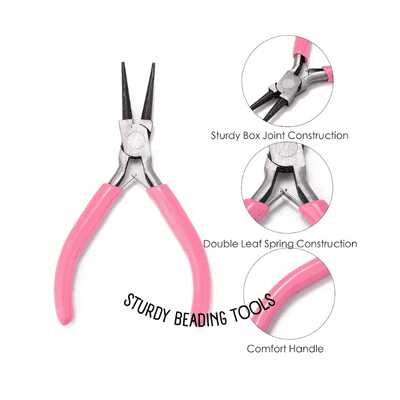
The most-used tool in any jeweller's kit. Round-nose pliers have tapered, conical jaws that let you create smooth, consistent loops in wire — essential for making ear wires, connecting links, wrapped loops, and attaching charms. Without these, wire work is nearly impossible.

Position your wire at the same point on the jaws each time to create loops of consistent size.
Flush Wire Cutters
★ Essential

A sharp pair of flush wire cutters makes clean, flat cuts close to the wire — leaving no rough "pinch" that could scratch the wearer. These work with beading wire (tigertail), head pins, eye pins, and most standard jewellery wires. Do not use standard flush cutters on memory wire, which requires its own heavy-duty cutter.

Always cut away from your face and hold the wire end to prevent it flying loose.
Crimping Pliers
★ Essential

Crimping pliers are used to secure crimp beads and crimp tubes onto beading wire — finishing your necklaces and bracelets with a neat, professional clasp connection. They have two channels: one to fold the crimp into a C-shape, and one to round it back into a neat cylinder. Far superior to simply squashing crimps flat with regular pliers.

Use micro-crimping pliers for delicate designs with 0.35mm beading wire.

Why quality tools matter for beginners

It's tempting to start with the cheapest tools available, but poor-quality pliers will frustrate you before you've finished your first bracelet. Jaw misalignment, rough edges, and weak springs make wire work inconsistent and tiring.

At Australia Beads, we stock tools that offer the right balance of affordability and quality for beginners — tools that will serve you well as your skills grow, rather than tools you'll need to replace after a month.

1998Est. by Melworks Beads
80K+Happy customers
6,000+Products in stock
02

Highly Recommended Next Steps

Expand your toolkit as your skills and projects grow

Flat-Nose Pliers
Recommended

Flat-nose pliers have smooth, flat jaws perfect for gripping wire, opening and closing jump rings, and bending sharp 90° angles. They are the ideal "second plier" — hold your work steady with flat-nose in one hand while manipulating with round-nose in the other.

Never use serrated jaw pliers on soft wire — they leave marks. Choose smooth-jaw flat-nose for a clean finish.
Chain-Nose Pliers
Recommended

Chain-nose pliers taper to a fine, flat point — ideal for reaching into tight spaces, gripping small jump rings, and working with fine chain. They're the workhorse of precision jewellery work. Many intermediate makers find themselves using chain-nose more than any other plier.

Two pairs of chain-nose pliers are the classic tool combination for opening and closing jump rings without distorting the round shape.
Bead Design Mat
Recommended

A non-slip bead mat might not look exciting, but it prevents beads rolling away and lets you lay out your design before stringing — saving you from constantly chasing runaway seed beads across your desk. The textured surface grips beads so they stay exactly where you put them.

Use a bead mat in a neutral grey or white to accurately see your bead colours before committing to a design.
Beading Needles
Recommended

If you're working with seed beads, peyote stitch, or any loom beading, a quality beading needle is non-negotiable. Beading needles are finer and more flexible than standard sewing needles, able to pass through the tiny holes in seed beads multiple times without bending or breaking the bead.

Size 10 or 12 needles work for most seed bead projects. Keep spares — they do bend.
03

Specialist Tools — Level Up

Tools that open up whole new jewellery-making techniques

Memory Wire Cutters
Specialist

Memory wire is hardened steel wire that holds its coiled shape — making beautiful stacking bracelets and necklaces with no clasps needed. However, this hardness will destroy regular flush cutters instantly. Heavy-duty memory wire cutters (end-nippers or heavy-duty diagonal cutters) are specifically designed for this job.

Never use your regular wire cutters on memory wire — even once will damage the blades permanently.
1-Step Looper ("Plooper")
Specialist

The 1-Step Looper by Beadsmith is a game-changing tool that simultaneously bends and cuts wire to create perfectly consistent simple loops on head pins and eye pins — in a single squeeze. Ideal for making earrings at scale or for anyone who struggles to make neat loops by hand.

Available in standard and "BIG" sizes — choose based on the gauge wire you use most often.
Bead Knotting Tool / Awl
Specialist

Traditional knotted pearl necklaces use a knot between each bead to protect them and create beautiful drape. A knotting tool or fine awl helps you position each knot precisely against the bead before tightening — a technique that's nearly impossible to do neatly with fingers alone.

A twisted wire needle threader makes silk cord threading much faster when knotting with very fine cord.
Thread Zap II
Specialist

The Thread Zap is a battery-powered pen tool with a heated metal tip that melts and seals synthetic thread ends cleanly — perfect for finishing kumihimo braids, macramé, and any project where you want a clean, melt-sealed end rather than a knot. A favourite for Fireline and other synthetic beading threads.

Works on synthetic threads only — nylon, Fireline, C-Lon. It will not work on natural silk or cotton threads.
By Technique

Which tools do you need
for your style?

Different jewellery-making styles call for different tool combinations. Here's a quick guide to what you'll need based on what you want to make.

Bead Stringing

The most beginner-friendly technique — threading beads onto wire or cord and finishing with a clasp. Clean, satisfying, and endlessly creative.

Crimping PliersWire CuttersBead Mat

Wire Wrapping

Using wire to create ornamental wraps, cages, and bezels around stones or beads. A hugely popular technique with a beautiful organic aesthetic.

Round-NoseChain-NoseFlush Cutters

Earring Making

Making ear wires and dangle earrings requires consistent loops for a professional result. A classic beginner project that creates an instant wearable result.

Round-NoseFlat-NoseWire Cutters

Seed Bead Stitching

Peyote, herringbone, right-angle weave — stitch-based beadwork creates intricate textile-like jewellery using tiny seed beads and beading thread.

Beading NeedlesBead MatScissors

Pearl Knotting

The traditional art of knotting between each pearl creates heirloom-quality necklaces with beautiful movement and protection for precious beads.

Knotting AwlBeading NeedlesScissors

Memory Wire Jewellery

Beading onto pre-coiled memory wire creates instant stacking bracelets and necklaces that hold their shape — no clasp needed and very beginner-friendly.

Memory Wire CuttersRound-NoseFlat-Nose

The Beginner's Buying Checklist

Before you spend a single dollar, use this checklist to make sure you're buying the right things in the right order.

  • Start with the Essential Three: Round-nose pliers, flush wire cutters, crimping pliers. These cover 80% of beginner projects.
  • Buy tools before buying beads: Many beginners do it backwards — then discover they can't finish their projects without the right tools.
  • Don't buy the cheapest possible tools: The extra $10–$20 for a quality pair of pliers pays for itself within the first project in time and frustration saved.
  • Add a bead mat: Costs almost nothing, saves enormous frustration when working with seed beads or small components.
  • Match tools to your technique: If you want to do wire wrapping, prioritise round-nose and chain-nose. Seed bead stitching? Prioritise needles and a good mat.
  • Store your tools properly: A simple tool roll or pouch keeps plier jaws from knocking together and dulling.
$30–50

Starter Kit Budget

Covers the Essential Three plus a bead mat. Plenty to complete your first 10–20 projects and learn all the fundamentals of jewellery making.

$150+

Advanced Toolkit

Adds specialist tools like a 1-Step Looper, memory wire cutters, Thread Zap, and knotting tools. For those who've caught the jewellery-making bug and want to explore every technique.

Expert Answers

Frequently Asked Questions

The three most important tools for a beginner are round-nose pliers (for making wire loops), flush wire cutters (for clean cuts on wire and head pins), and crimping pliers (for neatly finishing beading wire with crimp beads). With these three tools, you can make necklaces, bracelets, and earrings using beading wire, head pins, eye pins, and clasps. A bead mat is also strongly recommended as a very low-cost addition that prevents beads rolling away.
Standard household pliers are not recommended for jewellery making. They typically have serrated jaws that will leave marks and scratches on soft wire and findings. They are also too large to work with small components like jump rings and crimp beads. Jewellery-specific pliers have smooth jaws, appropriate jaw shapes, and fine tips for precision work. The price difference is modest and the quality difference is significant.
Round-nose pliers have completely round, tapered jaws — used for bending wire into circles and loops. Chain-nose pliers have jaws that are flat on the inside and taper to a fine point — used for gripping, opening jump rings, and reaching into tight spaces. Both are essential in a complete toolkit. If you are only buying one plier to start, round-nose is the better first choice for most beginners.
You can flatten crimp beads with flat-nose pliers to create a functional finish, but dedicated crimping pliers produce a far neater, more professional result. Crimping pliers fold the crimp into a compact cylinder that sits neatly and is less likely to have sharp edges. For beginners making their first projects, flat-nose pliers on crimps will work — but upgrading to proper crimping pliers is one of the best quality improvements you can make early on.
For making earrings, you need round-nose pliers (to create loops on head pins and eye pins), flat-nose or chain-nose pliers (to open and close jump rings and ear wires), and flush wire cutters (to trim excess wire from head pins). If you make a lot of earrings, the 1-Step Looper tool by Beadsmith dramatically speeds up loop-making and creates perfectly consistent loops every time.
Absolutely. Australia Beads has a wide network of international suppliers and can source specialist tools on request. Simply use the "Tool Request" button next to any out-of-stock tool, or contact us at [email protected] with the tool name and any relevant details. We'll get back to you with availability and pricing as soon as possible.

Ready to start making
beautiful jewellery?

Browse our Melbourne-stocked range of beading tools and jewellery making supplies — and if you can't find what you're looking for, just ask.

Shop All Tools

Gemstones have shaped human civilisation. They have decorated the crowns of emperors, been carried into battle as talismans of invincibility, ground into pigments that coloured the Virgin Mary's robes in Renaissance paintings, and traded across continents millennia before currency existed. Each stone embedded in the Earth carries a story as old as the planet itself.

This encyclopedia covers every major gemstone known to humanity, arranged alphabetically for easy reference. For each stone you'll find its geological origin, a visual description and a rich cultural history. Where a stone is available as beads through Australia Beads, we've linked directly so you can bring it into your next creation.

Agate → Azurite — 9 gemstones
Banded Agate gemstone with concentric coloured rings

Agate

Banded Agate · Moss Agate · Fire Agate

Quartz Chalcedony

Description

A microcrystalline variety of quartz distinguished by its striking concentric or wavy banding. Colours span white, grey, red, orange, brown and blue — each layer formed by repeated silica deposition within volcanic cavities. Translucency varies from near-opaque to glowing translucent.

Origin

Found worldwide — Brazil, Uruguay, India, China, Australia and the USA. Named after the Achates River (now Dirillo) in Sicily, where ancient Greeks first sourced it.

History

Among humanity's oldest ornamental stones, agate artefacts date back to 3000 BCE. Ancient Egyptians used it for amulets; Greeks and Romans carved cameos from it. Medieval Europeans believed it could neutralise venom and bestow eloquence on its wearer.

Alexandrite gemstone showing colour change

Alexandrite

Alexandrite Chrysoberyl · Alexandrite Effect

Rare Precious Chrysoberyl

Description

Famous for its dramatic colour-change phenomenon — green or teal in daylight, purplish-red under incandescent light. This effect is caused by chromium impurities absorbing light in a narrow band. Fine specimens rank among the world's most valuable gemstones per carat.

Origin

First discovered in the Ural Mountains of Russia in 1830. Significant deposits now exist in Brazil, Sri Lanka, Madagascar and East Africa.

History

Named in honour of Tsar Alexander II of Russia on his coming-of-age day. Its red-and-green duality mirrored Russia's imperial military colours, making it enormously fashionable. Original Ural alexandrites remain the most prized of all.

Vivid blue-green Amazonite gemstone

Amazonite

Amazon Stone · Green Feldspar

Feldspar Microcline

Description

A striking blue-green potassium feldspar, amazonite owes its vivid colour to trace amounts of lead and water within its crystal structure. Opaque to translucent, with natural white streaking that creates beautiful visual texture and a gentle schiller effect.

Origin

Colorado (USA), Brazil, Russia, Ethiopia, Madagascar and India. Despite its name, no significant deposits occur along the Amazon River.

History

Amazonite artefacts were found in Tutankhamun's tomb. Ancient Mesopotamians and pre-Columbian South Americans used it ornamentally. For centuries it was mistakenly believed to originate from the Amazon Basin, lending it an exotic mythology.

Sky-blue Aquamarine beryl crystal

Aquamarine

March Birthstone · Santa Maria Aquamarine

Precious Beryl

Description

A blue to blue-green beryl coloured by iron impurities, aquamarine ranges from pale sky blue to deep ocean teal. The prized "Santa Maria" variety from Brazil commands premium prices for its saturated, vivid blue. Typically very clean and transparent, Mohs 7.5–8.

Origin

Brazil (Minas Gerais) dominates global supply. Notable deposits also in Nigeria, Zambia, Pakistan, Mozambique and Madagascar.

History

Ancient Romans believed aquamarine was sacred to Neptune and sailors carried it for protection at sea. Medieval Europeans used it to improve eyesight and reveal truth. One of the most celebrated aquamarines is the 110.5-carat Roosevelt Aquamarine, gifted to Eleanor Roosevelt by the Brazilian government in 1936.

Green Aventurine showing aventurescence

Aventurine

Green Aventurine · Blue Aventurine

Quartz Feldspar

Description

A sparkling form of quartz characterised by aventurescence — a glittery metallic shimmer produced by tiny reflective mica inclusions. Most commonly green but also appears in orange, red, blue, yellow and grey. Long used as a jade substitute in East Asian decorative arts.

Origin

India (Mysore) is the primary source. Other deposits in Russia, Brazil, Austria, Tanzania and the USA.

History

The name derives from the Italian "a ventura" (by chance), referring to the accidental 18th-century discovery of aventurine glass. Tibetan statues have incorporated aventurine eyes for thousands of years. Indian artisans have carved it into figurines and jewellery for millennia.


B
Beryl → Blue Lace Agate — 3 gemstones
Clear Beryl crystal mineral specimen

Beryl

Parent of Emerald, Aquamarine, Morganite, Heliodor

Precious Family Silicate

Description

A beryllium aluminium silicate producing some of Earth's finest gemstones. Pure beryl is colourless (goshenite); chromium creates emerald's green; iron yields aquamarine blue or heliodor yellow; manganese forms morganite's blush pink. Hardness 7.5–8 makes it very suitable for all jewellery types.

Origin

Found in granitic pegmatites and metamorphic rocks globally. Major sources in Colombia, Brazil, Russia, Pakistan, Afghanistan and Africa.

History

The Romans fashioned the first corrective lenses from polished beryl. Emperor Nero reportedly peered through a large emerald (beryl) to watch gladiatorial combat, using it as a colour filter. Beryl has been mined for at least 2,000 years continuously.

Dark green Bloodstone with red inclusions

Bloodstone

Heliotrope · Martyr's Stone

Chalcedony

Description

A dark green variety of chalcedony scattered with vivid red flecks of iron oxide, dramatically evoking drops of blood against forest green. A traditional March birthstone and one of the most historically loaded gemstones in existence.

Origin

India's Kathiawar peninsula produces the finest. Other sources include Brazil, China, Australia and the USA.

History

Medieval Christians called it the "martyr's stone," believing its red spots were Christ's blood fallen on jasper at the Crucifixion. Ancient Egyptians and Greeks used it in amulets. Medieval European healers considered it one of the most powerful healing stones, capable of stopping haemorrhages and curing blood diseases.

Pale blue banded Blue Lace Agate

Blue Lace Agate

Variety of Banded Chalcedony

Chalcedony Quartz

Description

A delicate pale blue to white banded chalcedony distinguished by its soft lacy patterns and translucent, cloud-like quality. Among the most popular beading stones for its serene, sky-like hues — perfect for minimalist and boho jewellery styles alike.

Origin

Originally discovered in Namibia in the 1960s. Small deposits also exist in Romania and the USA.

History

Introduced to gem collectors by George Swanson, who discovered it in Namibia and recognised its ornamental potential. It quickly became a staple of crystal healing and jewellery making for its gentle aesthetic and calming associations.


C
Carnelian → Coral — 5 gemstones
Warm orange-red Carnelian gemstone

Carnelian

Cornelian · Red Agate · Sardius

Chalcedony

Description

A reddish-orange to deep red translucent chalcedony coloured by iron oxide. Its warm fire-like transparency and smooth waxy lustre make it one of the most universally appealing gemstones for beadwork. Heat treatment from India intensifies the colour of commercial stones.

Origin

India (Gujarat) is the premier source. Also found in Brazil, Uruguay, Siberia and Germany.

History

One of the oldest gemstones used continuously by humanity. Egyptian dead were buried with carnelian for afterlife protection. Romans engraved it as signet seals because wax doesn't stick to it. Napoleon carried a carnelian seal looted from Egypt. Islamic tradition holds it especially sacred — the Prophet Mohammed wore a carnelian ring.

Vivid apple-green Chrysoprase

Chrysoprase

Australian Jade · Apple Green Chalcedony

Chalcedony

Description

The finest and most valuable chalcedony variety, chrysoprase is a vivid apple-to-mint green coloured by nickel silicate inclusions. Top-grade material is translucent with an intense, saturated green that rivals fine jade. Australia is a major producer of world-class material.

Origin

Australia (Queensland and Western Australia) produces the world's finest. Other sources include Poland (historical), Brazil, Tanzania and the USA.

History

Mentioned by Pliny the Elder and prized throughout antiquity. Alexander the Great reportedly wore chrysoprase in his belt for invincibility. Medieval Europeans believed it made thieves invisible. Australia's discovery of major deposits in the 20th century brought chrysoprase to global gem markets at scale.

Golden yellow Citrine quartz

Citrine

November Birthstone (alternate) · Merchant's Stone

Quartz

Description

A transparent yellow to orange-brown quartz, citrine's warm tones range from pale lemon through golden honey to deep amber. The world's most commercially important yellow gemstone. Natural citrine is far rarer than heat-treated amethyst, which produces similar colours and makes up most market supply.

Origin

Brazil (Rio Grande do Sul) dominates production. Also found in Bolivia, Madagascar, Russia and Scotland.

History

Known as the "merchant's stone" for centuries, carried to attract prosperity. The Romans fashioned it into cabochons and intaglios. During the 1930s–50s Art Deco era, large faceted citrines became hugely fashionable in Hollywood jewellery. Scottish Highland dress has long incorporated large citrine brooches as traditional ornamentation.


D
Diamond → Dumortierite — 2 gemstones
Rough diamond crystal octahedron

Diamond

April Birthstone · King of Gems · Pure Carbon

Rare Precious

Description

The hardest natural substance on Earth (Mohs 10), diamond is pure carbon crystallised under extreme heat and pressure 100–200 km below the surface. Its extraordinary brilliance comes from a very high refractive index; its fire from strong dispersion. Evaluated by the 4Cs: cut, colour, clarity and carat.

Origin

Delivered to the surface by volcanic kimberlite pipes. Major producers: Russia (Alrosa), Botswana (Debswana), Canada, Angola and Australia — the now-closed Argyle mine in Western Australia was the world's leading source of rare pink diamonds.

History

First mined in India's legendary Golconda region, whose stones — including the Hope Diamond and Koh-i-Noor — remain the most storied in history. Ancient Hindus considered it sacred to Indra, king of gods. The modern engagement ring tradition was cemented by De Beers' 1947 campaign — widely considered the most effective advertising slogan in history: "A Diamond is Forever."

Dark indigo-blue Dumortierite

Dumortierite

Blue Quartz (when included in quartz)

Silicate

Description

A deep blue to violet-blue orthorhombic silicate, often found as inclusions within quartz creating rich "blue quartz" cabochons. Its distinctive violet-blue makes it a popular lapidary material for beads and carvings with a distinctive inky hue.

Origin

Brazil, France (first described), Mozambique, Namibia, Madagascar, Norway, Poland and the USA.

History

Described and named in 1881 after French palaeontologist Eugène Dumortier. Historically valued for making high-quality porcelain and refractory ceramics before its gem potential was recognised. Its popularity as a lapidary stone has grown steadily through the 20th and 21st centuries.


E
Emerald — 1 gemstone
Deep green faceted Emerald gemstone

Emerald

May Birthstone · Green Beryl

Rare Precious Beryl

Description

The most precious of all green gemstones — a chromium-coloured beryl displaying vivid "emerald green." Internal inclusions called "jardin" (French for garden) are considered part of the stone's personality. Colombian emeralds from the Muzo and Chivor mines represent the world's finest, with a warm, slightly bluish-green hue and extraordinary depth.

Origin

Colombia (Muzo and Chivor mines) produces the world's finest. Other sources: Zambia (deep, slightly bluish green), Brazil, Zimbabwe, Afghanistan, Pakistan and Ethiopia.

History

Mined in Egypt since at least 1500 BCE — Cleopatra's emerald mines in the Eastern Desert are among the oldest in recorded history. Aztecs and Incas considered emeralds sacred. Spanish conquistadors seized enormous quantities from South America. The 217.80-carat Mughal Emerald, inscribed with Islamic prayers, sold at auction in 2001 for $2.2 million.


F
Fluorite — 1 gemstone
Multi-colour banded Fluorite crystals

Fluorite

Rainbow Fluorite · Fluorspar · Blue John (UK variety)

Halide

Description

One of the world's most colourful minerals, occurring in virtually every colour — purple, green, yellow, blue, pink, colourless — and spectacular multi-colour banding. Defines Mohs hardness 4 and was the first mineral found to exhibit fluorescence under UV light, giving the phenomenon its name.

Origin

Worldwide. Major gem-quality sources in China, Mexico, South Africa, Spain, Namibia and the UK (Derbyshire Blue John variety).

History

Ancient Egyptians and Romans carved it into luxury vessels and amulets. Romans believed fluorite vessels prevented drunkenness. Derbyshire's "Blue John" fluorite has been mined in England for 300+ years and is protected as a national heritage mineral. Fluorite was also pivotal to atomic energy development as the primary source of fluorine.


G
Garnet → Goldstone — 2 gemstones
Deep red Garnet gemstone

Garnet

January Birthstone · Almandine · Pyrope · Tsavorite · Demantoid

Precious Silicate Group

Description

Not a single mineral but a diverse group of silicate minerals sharing a cubic crystal structure. Garnet occurs in almost every colour — the rare green demantoid and vivid tsavorite are the most valuable; deep red pyrope and almandine the most recognised. Hardness 6.5–7.5. Demantoid has higher dispersion than diamond.

Origin

Found worldwide. Tsavorite from Kenya and Tanzania; demantoid from Russia and Namibia; spessartine from Nigeria and Mozambique; rhodolite from North Carolina, USA.

History

One of the oldest gemstones in continuous use — found in Egyptian jewellery from 3100 BCE. Anglo-Saxons set red garnets in gold sword hilts and brooches. Medieval travellers carried garnet for protection on journeys. Bohemian pyrope garnet jewellery was the height of fashion in 19th-century Europe.


H
Hematite → Howlite — 2 gemstones

I
Iolite · Iolite — 1 gemstone
Violet-blue Iolite gemstone faceted

Iolite

Water Sapphire · Viking Compass Stone · Cordierite

Silicate

Description

A violet-blue silicate exhibiting remarkable strong pleochroism — it appears blue-violet from one direction, yellow-grey from another and near-colourless from a third. This extraordinary optical property made it historically invaluable to Viking navigators. Often called a budget alternative to tanzanite and sapphire.

Origin

India, Sri Lanka, Mozambique, Zimbabwe, Brazil, Canada and Norway.

History

Viking navigators used thin slices of iolite as a polarising light filter to locate the sun on overcast days — possibly the world's oldest documented navigational instrument. The pleochroic effect allowed determination of the sun's position even when below the horizon. This remarkable use may have enabled Viking oceanic navigation centuries before the magnetic compass reached Europe.


J
Jade → Jasper — 2 gemstones

K
Kunzite → Kyanite — 2 gemstones
Pale pink Kunzite crystal

Kunzite

Pink Spodumene · Evening Stone

Pyroxene

Description

A transparent, pastel pink to lilac-pink gem variety of spodumene, coloured by manganese. Strongly pleochroic and prone to fading in prolonged sunlight (hence "evening stone"). Large crystals are common, making for impressive statement gems. Mohs 6.5–7.

Origin

Afghanistan, Pakistan and Brazil are the primary sources. Also USA (California), Madagascar and Myanmar.

History

Named after pioneering American gemmologist George Frederick Kunz, who first described it in 1902. A 47-carat kunzite ring was among Jackie Kennedy's cherished possessions. Being a modern discovery, kunzite lacks ancient lore but has rapidly become a romantic jewellery staple for its soft, feminine hues.

Blue bladed Kyanite crystals

Kyanite

Disthene · Blue Spar

Silicate

Description

A distinctly bladed blue silicate whose hardness varies by direction (4.5 along crystal length, 6.5 across) — a unique property called anisotropy. Gem quality kyanite is a beautiful sapphire-blue. Also occurs in green, orange, black and yellow. Typically untreated — no heat or clarity enhancements required.

Origin

Nepal, Brazil, India and Kenya. Also Russia, Austria, Switzerland and the USA.

History

From the Greek "kyanos" meaning blue. Long an industrial mineral (porcelain, refractory ceramics, electrical insulators) before its gem potential was fully appreciated. Increasingly sought in contemporary jewellery for its natural, enhancement-free beauty and distinctive structural character.


L
Labradorite → Lapis Lazuli — 2 gemstones
Labradorite showing spectacular labradorescence

Labradorite

Spectrolite (Finland) · Rainbow Moonstone (trade)

Feldspar

Description

Famous for its breathtaking labradorescence — intense iridescent flashes of blue, green, gold, orange and violet that appear to shimmer beneath the surface as the stone is turned. Produced by light interference between twinned crystal layers. Finnish spectrolite displays the full colour spectrum simultaneously.

Origin

First described from Paul's Island, Labrador, Canada. Major gem sources in Madagascar (most of global supply), Finland (spectrolite), Russia and Mexico.

History

Inuit legend holds that a warrior struck the Labrador rocks to free the Northern Lights trapped within — and some light remained in the stones forever. Discovered by Moravian missionaries in 1770. Finnish spectrolite, discovered in the 1940s, is the most prized variety. Labradorite is now among the most universally loved beading stones for its otherworldly visual drama.


M
Malachite → Moonstone — 3 gemstones
Pale pink Morganite beryl gemstone

Morganite

Pink Beryl · Rose Beryl · Vorobyevite

Precious Beryl

Description

The pink to peach-pink beryl, coloured by manganese. Its warm blush-to-salmon hues have made it one of the most fashionable gemstones of the 21st century — especially in rose gold engagement ring settings. Hard (Mohs 7.5–8), durable, and typically free of inclusions.

Origin

Brazil is the primary source; Madagascar yields exceptional large crystals. Also from the USA (California), Afghanistan and Mozambique.

History

Named by gemmologist George Frederick Kunz in 1910 after financier J.P. Morgan — a significant gem collector and benefactor of New York's American Museum of Natural History. Long overlooked in favour of pink tourmaline, morganite exploded in popularity from 2010 when rose gold jewellery became a global fashion force.


N
Nuummite — 1 gemstone
Dark Nuummite with iridescent gold flashes

Nuummite

Sorcerer's Stone · World's Oldest Gemstone

Rare Amphibole

Description

One of Earth's oldest gemstones at approximately 3 billion years old, nuummite is a metamorphic rock composed of gedrite and anthophyllite amphiboles. Its dark, almost black surface is ignited by brilliant flashes of gold, copper, red, green and blue — a phenomenon called schiller. Each stone resembles a miniature captured cosmos.

Origin

Found almost exclusively near Nuuk, southwest Greenland. Extremely rare and only accessible during summer months when the Arctic terrain is navigable.

History

Used by indigenous Inuit people of Greenland for thousands of years as a protective talisman. Modern gem use began after geologists formally documented it in the 1980s. Its extraordinary age — formed before complex life existed on Earth — makes it among the most metaphysically powerful stones in crystal healing traditions worldwide.


O
Obsidian → Onyx — 2 gemstones
Shiny black volcanic Obsidian

Obsidian

Volcanic Glass · Apache Tears · Snowflake Obsidian

Volcanic Glass

Description

A naturally occurring volcanic glass formed when silica-rich lava cools rapidly. Deep black and glassy, it fractures conchoidally (in smooth curved shells) to produce razor-sharp edges sharper than surgical steel. Varieties include mahogany obsidian (brown streaks), snowflake obsidian (white spherulite patterns) and rainbow obsidian (iridescent sheen).

Origin

Found wherever there is or was volcanic activity — Mexico, USA (Oregon, California), Iceland, Japan, Turkey and Armenia (one of the ancient trade routes' most important commodities).

History

Obsidian tools represent some of the earliest known human technology, used for knives, arrowheads and surgical blades since the Palaeolithic. Ancient trade routes carrying obsidian across continents have been archaeologically mapped. Aztec priests used obsidian mirrors for divination and ritual sacrifice. Aztec deity Tezcatlipoca was "Lord of the Smoking Mirror" — an obsidian mirror. Obsidian scalpels are still used in some modern eye surgeries for their unrivalled edge.


P
Pearl → Pyrite — 4 gemstones
Lustrous white Pearl in oyster shell

Pearl

June Birthstone · Akoya · South Sea · Tahitian · Freshwater

Organic Precious

Description

The only gemstone created by a living organism, pearls form when a mollusc secretes nacre around an irritant. Their luminous quality — called orient — results from light diffracting through hundreds of concentric nacre layers. Natural wild pearls are exceptionally rare today; virtually all commercial pearls are cultured.

Origin

South Sea pearls (largest) from Australia, Indonesia and the Philippines. Tahitian black pearls from French Polynesia. Akoya pearls from Japan. Freshwater pearls predominantly from China.

History

The oldest known jewel — pearl necklaces found in Persian royal tombs date to 520 BCE. In ancient Rome, only the highest social ranks could legally wear pearls. Cleopatra famously dissolved a pearl in vinegar and drank it to win a wager about hosting the most expensive banquet in history. Australia's South Sea pearl industry is world-renowned, producing the largest and finest cultured pearls on Earth.

Bright lime-green Peridot gemstone

Peridot

August Birthstone · Gem of the Sun · Olivine

Olivine

Description

One of the few gemstones existing in only one colour — a distinctive lime to olive green determined by iron content. Unlike most gems, peridot forms in Earth's mantle and reaches the surface through volcanism. Extraordinarily, it has been found in pallasite meteorites — making it a true cosmic gemstone.

Origin

Pakistan (Kohistan, finest quality), Myanmar, the historic Zabargad island (Red Sea, Egypt), Arizona (Navajo lands), China and Australia.

History

Ancient Egyptians called it the "gem of the sun" and mined Zabargad island under heavily guarded secrecy. Many of Cleopatra's famous "emeralds" were likely peridot. Medieval European Crusaders brought it back from the Holy Land and set it in cathedral treasures. The 200-carat gems on Cologne Cathedral's Three Kings shrine were long believed to be emeralds — they are peridot.

Pink and black veined Rhodonite

Prehnite

Grape Jade (trade) · Stone of Prophecy

Silicate

Description

A pale, translucent yellow-green to apple-green silicate mineral with an oily to waxy lustre. Often occurs in botryoidal (grape-cluster) formations. Fine specimens are beautifully translucent with a soft inner glow. Frequently contains black tourmaline or epidote inclusions that create dramatic internal landscapes.

Origin

South Africa (first described), Australia (striking specimens from Halls Creek WA), China, Mali, Scotland and the USA.

History

Named after Colonel Hendrik von Prehn, who brought specimens from the Cape Colony to Europe around 1774 — making prehnite the first mineral named after a specific person. South African Xhosa shamans reportedly used it for divination and prophetic dreaming, earning it the moniker "stone of prophecy." Its jade-like appearance drives strong demand in Asian markets.

Cubic golden metallic Pyrite crystals

Pyrite

Fool's Gold · Iron Pyrite · Marcasite (cut form)

Sulfide

Description

An iron sulfide mineral celebrated for its brassy gold metallic lustre. Crystals form perfect cubes, octahedra and pyritohedra. Cut and polished as "marcasite" in Victorian jewellery, it displays metallic fire unlike any other stone. Despite its nickname, fool's gold is a fascinating gem in its own right.

Origin

Worldwide. Exceptional crystals from Navajún, Spain; Peru; Italy and the USA.

History

Used by pre-Columbian Americans to create polished scrying mirrors. Aztec priests made pyrite mosaic mirrors for ritual divination. The Romans used it as a fire-starter (Greek "pyr" = fire). Victorian jewellery used cut pyrite as "marcasite" — a fashion that persists powerfully in vintage and retro jewellery today.


R
Rhodonite → Ruby — 3 gemstones
Pink and black Rhodonite gemstone

Rhodonite

Rose Stone · Manganese Silicate

Pyroxenoid

Description

A rose-pink to deep red manganese silicate dramatically veined with black manganese oxide. The stark contrast between vivid pink and jet-black veining creates striking organic patterns. Rhodochrosite is a more translucent, closely related pink stone.

Origin

Russia's Ural Mountains (classic source), Australia, Sweden, Brazil, USA and Peru.

History

From the Greek "rhodon" — rose. Revered by Russian tsars who used it for sarcophagi, columns and grand ornamental objects. The Trans-Siberian Railway's Ekaterinburg station was decorated with rhodonite. Russia designated it the national stone in 1913. Today it is also the official state gem of Massachusetts, USA.

Deep pigeon's blood red Ruby gemstone

Ruby

July Birthstone · King of Precious Stones · Red Corundum

Rare Precious Corundum

Description

The red variety of corundum (aluminium oxide), coloured by chromium. The finest "pigeon's blood" rubies from Myanmar are a vivid, slightly bluish-red with strong fluorescence under UV. Fine rubies command higher per-carat prices than diamonds. Mohs 9 — the second hardest natural gemstone after diamond.

Origin

Myanmar's Mogok Valley produces legendary pigeon's blood rubies. Mozambique has emerged as a major modern source. Also Thailand, Sri Lanka, Cambodia, Afghanistan and Greenland.

History

In ancient India, the Sanskrit "ratnaraj" means "king of precious stones." Ancient Burmese warriors inserted rubies under their skin before battle for invincibility. Medieval Europeans believed rubies could predict danger by darkening in colour. The famous "Black Prince's Ruby" in Britain's Imperial State Crown is actually a spinel — underlining how frequently ruby has been confused with other red gems throughout history.


S
Sapphire → Sunstone — 5 gemstones
Cornflower blue faceted Sapphire

Sapphire

September Birthstone · Padparadscha · All Non-Red Corundum

Rare Precious Corundum

Description

All gem-quality corundum except red (ruby) is called sapphire. While most famous in vivid cornflower blue (from iron and titanium), sapphire occurs in pink, yellow, orange, purple, green and colourless — and the extraordinary padparadscha (salmon-pink to orange-pink). Mohs 9, exceptionally hard and durable.

Origin

Kashmir produced the legendary velvety "cornflower blue" (now depleted). Myanmar, Sri Lanka (padparadscha and fine blues), Madagascar and Australia (dark blue) are major sources.

History

Ancient Persians believed the sky was blue because Earth rested on a giant sapphire. Medieval clergy wore it as a symbol of heaven. Greeks wore it for wisdom when consulting the Oracle at Delphi. Princess Diana's 18-carat oval Kashmir sapphire engagement ring — now worn by Catherine, Princess of Wales — is the world's most famous sapphire jewel.

Vivid red faceted Spinel gemstone

Spinel

August Birthstone (added 2016) · Balas Ruby (historical)

Rare Precious Oxide

Description

A magnesium aluminium oxide in rich red, hot pink, vivid orange (flame spinel), brilliant cobalt blue and violet. For centuries confused with ruby — many of history's greatest "rubies" proved to be spinel on scientific examination. Fine red spinels rival top rubies in colour intensity and brilliance.

Origin

Myanmar's Mogok Valley (finest reds alongside ruby), Tajikistan, Sri Lanka, Mahenge Tanzania (famous hot pink and orange), Vietnam and Madagascar.

History

The "Black Prince's Ruby" in Britain's Crown Jewels is a spinel. So are multiple stones in the Russian and Iranian crown jewels. For centuries these were all considered rubies. Spinel was finally correctly identified in 1587. Added as an August birthstone by the American Gem Trade Association in 2016 — long overdue recognition for one of the world's most beautiful gems.

Sparkling orange Sunstone feldspar

Sunstone

Heliolite · Oregon Sunstone · Gold Sandstone

Feldspar

Description

A feldspar exhibiting aventurescence — brilliant, glittery sparkle caused by tiny hematite or copper platelets reflecting light. Colours from pale yellow to deep orange, red and green. Oregon sunstone is unique as its sparkle derives from native copper rather than iron, producing extraordinary colour-change and pleochroism.

Origin

Oregon, USA (rare gem-quality copper sunstones), Norway, India, Canada and Australia.

History

Viking legend connects sunstone to their "sólarsteinn" navigation stone. Native Americans of the Pacific Northwest used Oregon sunstone in trade and ceremony for millennia before European contact. Oregon designated it the official state gemstone in 1987.


T
Tanzanite → Turquoise — 5 gemstones
Violet-blue Tanzanite gemstone

Tanzanite

December Birthstone (2002) · Blue-Violet Zoisite

Rare Precious

Description

A blue to violet zoisite displaying exceptional pleochroism — blue, violet and burgundy-red in different directions. Heat treatment converts its naturally reddish-brown colour to the coveted blue-violet. Found in only one place on Earth: a 7 km² zone in Tanzania. Geologists predict commercially viable supply may be exhausted within decades.

Origin

Found exclusively in the Merelani Hills near Arusha, Tanzania. One of the rarest gemstone localities on Earth.

History

Discovered in 1967 by Maasai tribesman Ali Juuyawatu. Tiffany & Co. named it tanzanite and marketed it as "found in only two places — Tanzania and Tiffany's." The most rapidly accepted new gemstone in history. Tanzania has since banned rough tanzanite exports to develop a local cutting industry, adding national economic significance to its remarkable story.

Golden chatoyant Tiger's Eye

Tiger's Eye

Bull's Eye (red) · Hawk's Eye (blue) · Cat's Eye Quartz

Quartz

Description

A golden to honey-brown chatoyant quartz displaying a shifting silky band of light — chatoyancy — produced by parallel fibres of crocidolite asbestos replaced by quartz and iron oxide. The light band moves across the stone as it is rotated, vividly mimicking a feline eye. Hawk's eye (blue) is the unoxidised variety; bull's eye (red) is heat-treated.

Origin

South Africa (Northern Cape) is the primary source. Also Australia, India, Burma, USA and Namibia.

History

Ancient Egyptians used tiger's eye for the divine eyes of their deity statues. Roman soldiers carried it into battle for protection. In the Far East it was carried as a talisman against the evil eye. Its extraordinary optical effect has made it one of the most consistently popular cabochon and bead stones in jewellery making through all eras and cultures.

Blue Topaz crystal Brazil

Topaz

November Birthstone · Imperial Topaz · Blue Topaz · Mystic Topaz

Precious Silicate

Description

A fluorine-bearing silicate in a spectacular range of colours. Pure topaz is colourless; impurities create blue, yellow, orange, pink, red and brown. "Imperial topaz" — a warm orange-gold to pink-orange from Brazil — is the most prized and valuable. Blue topaz (typically irradiation-treated) dominates the commercial market by volume.

Origin

Brazil (Ouro Preto — finest Imperial topaz). Large blue topaz from Pakistan, Russia, Australia and Nigeria. The Ural Mountains' historical pink-blue topaz was once considered more valuable than diamond.

History

Ancient Greeks believed topaz could make its wearer invisible and increase physical strength. Medieval Europeans thought it could cure madness. The 1680-carat "Braganza Diamond" in the Portuguese Crown is almost certainly a colourless topaz. The word may derive from Topazos island in the Red Sea (now Zabargad — actually the source of peridot), reflecting ancient gem-naming confusion.


U
Unakite — 1 gemstone
Unakite — olive-green and salmon-pink metamorphic rock

Unakite

Epidosite · Unakite Jasper (trade)

Metamorphic Rock

Description

A mottled metamorphic rock of pink orthoclase feldspar, green epidote and colourless quartz. Its instantly recognisable olive-green and salmon-pink patterning is unique in the mineral world. Takes a good polish and is prized for cabochons, beads and carvings in earthy, autumnal palettes.

Origin

First described from the Unaka Mountains of North Carolina and Tennessee, USA. Also found in Virginia, South Africa, Sierra Leone and Brazil.

History

Named after the Unaka Mountains. Used by Native Americans of the Appalachian region for tools and ornaments. Popularised during the 20th-century lapidary movement, unakite is now a beloved beadwork stone for its distinctive earthy colourway and the way it pairs naturally with wood and leather in bohemian designs.


V
Variscite → Vesuvianite — 2 gemstones
Variscite — vivid apple-green phosphate gemstone

Variscite

Utahlite · Amatrice

Phosphate

Description

A green hydrated aluminium phosphate often mistaken for turquoise, but distinctly more vivid green (apple to mint) rather than blue-green. Fine Utah material displays exceptional apple-green with white matrix veining that is visually distinct from any other stone.

Origin

Utah, USA (premier gem quality). Also Germany (first described — Variscia region), Spain, Czech Republic and Australia.

History

First described in 1837. Long sold as turquoise. Native American jewellers of the Southwest used Utah variscite as a turquoise substitute for generations. Its distinct green identity was only broadly recognised in the 20th century, finding its market among collectors and jewellers seeking a true apple-green stone.

Vesuvianite — calcium silicate from Mount Vesuvius

Vesuvianite

Idocrase · Californite (jade-like variety) · Cyprine (blue)

Silicate

Description

A complex calcium aluminium silicate in yellow, green, brown, blue and purple. The opaque green "californite" closely resembles jade and is carved into ornamental objects; transparent faceted vesuvianite is a collector's gem. Blue cuprian vesuvianite (cyprine) is among the rarest natural blue gems on Earth.

Origin

First found in lavas of Mount Vesuvius. Gem quality from Italy, Canada, Russia, Pakistan, USA (California) and Kenya.

History

Described from Monte Somma, Vesuvius in 1795. Californite was used by Native Californians as a jade substitute for tools and ornaments. Its transparent varieties were favoured by Victorian gem cutters before largely falling from fashion. Modern collector interest has created renewed appreciation for this characterful, diverse mineral group.


W
Wulfenite — 1 gemstone
Wulfenite — vivid orange lead molybdate crystals

Wulfenite

Yellow Lead Ore · Arizona Sunstone (informal)

Rare Molybdate

Description

A vivid orange to yellow lead molybdate forming striking square, flat crystals with an intense colour rivalling fire opal. Too soft and fragile (Mohs 2.75–3) for conventional jewellery, it is one of the most spectacular mineral collector specimens in the world, occasionally used in bezel-set or carved pieces by specialised artisans.

Origin

The Red Cloud Mine, Arizona (finest specimens), Ojuela Mine, Mexico, Slovenia (Bleiberg — type locality), Morocco and Namibia.

History

Named in 1845 after Austrian mineralogist Franz Xavier von Wulfen. Among collectors, wulfenite is one of the most coveted display minerals globally — its brilliant orange crystals against white calcite are considered among the most photogenic of all minerals. Arizona designated it the official state mineral in 2012.


Z
Zircon → Zoisite — 2 gemstones
Brilliant blue faceted Zircon gemstone

Zircon

December Birthstone (alternate) · Blue Zircon · Jacinth (red)

Precious Silicate

Description

Not to be confused with synthetic cubic zirconia, natural zircon is a zirconium silicate with extraordinary fire and brilliance historically used as a diamond simulant. Occurs in blue (most sought), golden yellow, orange, red, green and colourless. Contains the oldest known mineral grains on Earth — up to 4.4 billion years old.

Origin

Cambodia (finest blue zircon), Sri Lanka, Myanmar, Tanzania and Australia — Jack Hills in Western Australia contains the world's oldest zircon crystals, making Australia central to our understanding of early Earth.

History

Medieval Europeans called it "jacinth" (orange-red) and "ligure" (blue), attributing it with protective powers against evil spirits. Nearly as prized as diamond in Victorian England. Jack Hills zircon from Western Australia is studied scientifically as a time capsule of early Earth conditions. Despite widespread historical use, zircon often suffers from confusion with synthetic cubic zirconia — an entirely different material.

Pink Zoisite Thulite specimen

Zoisite

Parent of Tanzanite · Anyolite (Ruby-in-Zoisite) · Thulite (pink)

Silicate

Description

A calcium aluminium silicate best known as the parent mineral of tanzanite. Anyolite (ruby-in-zoisite) is a dramatic Tanzanian combination — bright green zoisite matrix with vivid ruby crystals and black hornblende, carved into extraordinary sculptures and beads. Thulite is its manganese-bearing pink variety.

Origin

Named after Slovenian Baron Sigismund Zois who funded its first description in 1805. Anyolite from Tanzania; thulite from Norway; tanzanite (blue zoisite) from Tanzania.

History

Zoisite was an obscure collector's mineral until tanzanite's 1967 discovery transformed it into one of the world's most commercially significant gem parents. Ruby-in-zoisite (anyolite) from Tanzania gained rapid popularity from the 1960s for large carvings. Thulite from Norway, named after the mythical land of Thule, has been used in Scandinavian folk jewellery for centuries.

Ready to Create with Gemstones?

Australia Beads stocks dozens of genuine gemstone bead varieties — from the mystical shimmer of moonstone and labradorite to the rich greens of malachite and serpentine. Fast Australian shipping.

Explore All Gemstone Beads →
By |2026-04-03T21:09:37+00:00March 14th, 2026|Articles|0 Comments

3 Easy Beading Projects for Complete Beginners

3 Easy Beading Projects for Beginners (Step-by-Step with Materials Lists) | Australia Beads
Australia Beads  ·  Est. 1998

3 Easy Beading Projects
for Complete Beginners

Step-by-step illustrated instructions and complete materials lists for your first bracelet, earrings, and necklace — all achievable in an afternoon.

📅 Updated March 2025 🕐 15 min read ⭐ Beginner Friendly
AB
Written by Australia Beads

One of Australia's original online bead stores, founded in Melbourne in 1998. Over 25 years supplying jewellery makers — from first-timers to professional designers — with beads imported from more than 15 countries worldwide.

The best way to learn beading is to make something. Not to read more about beading — to actually sit down, thread some beads, and finish a piece you can wear or give away. These three projects are designed for that: achievable in an afternoon, using inexpensive materials, each teaching core techniques you'll use in almost everything you ever make.

Complete all three and you'll have covered elastic stringing, crimping, wire loops, and jump ring technique — the foundation of the vast majority of jewellery projects.

In This Guide
01
15 min  ·  No tools
02
20 min  ·  Basic pliers
03
30 min  ·  Crimping pliers
📋 Before You Begin

Read each project fully before starting. Gather all materials first — mid-project supply runs are the most common reason beginners abandon their first piece. All products linked in the materials lists are available from Australia Beads.

01
Project One

The Elastic Stretch Bracelet

Time
15 minutes
🛠
Tools
None needed
💰
Cost
~$8–15 AUD
Level
Complete Beginner

This is the project we recommend every beginner start with. No tools, no clasps, no crimping — just beads and elastic. You'll finish it in 15 minutes, it will fit perfectly, and you'll understand the fundamental rhythm of beading.

Colourful glass beads for making a stretch bracelet — ideal beginner jewellery making project

Materials List

Item Specification Qty Shop
Glass round beads8mm, your choice of colour~23 beadsShop →
Elastic cord1mm thickness, clear or white~30cmShop →
Jewellery glueG-S Hypo Cement or similar1 tubeShop →
Bead matVelvet or foam, any size1Shop →
Optional upgrade

Add a few 4mm metal spacer beads between every 3rd glass bead — it makes your first bracelet look deliberately designed rather than beginner-made.

Step-by-Step Instructions

1
📏
Measure
Measure your wrist

Wrap a strip of paper around your wrist where you'd wear a bracelet. Add 1cm for comfort. Most adult wrists are 16–18cm. Cut your elastic to this length plus 10cm extra for knotting (typically 27–29cm total).

2
🪢
Prepare
Tie a stopper knot

Tie a loose overhand knot about 5cm from one end of the elastic — just to stop beads sliding off while you work. Don't cut this end yet.

3
🔵
Thread
Thread your beads

Lay your bead mat flat. Thread beads onto the elastic in your chosen pattern. For 8mm beads, you'll need approximately 23 beads for an 18cm bracelet. Hold the strand against your wrist to check length before finishing.

4
Knot
Tie the surgeon's knot

Remove the stopper knot. Bring both ends of elastic together and tie a surgeon's knot: cross right over left and through twice, then left over right and through once. Pull very firmly so beads have slight tension — not loose, not stretched.

end A end B pull → pull → cross ×2 cross ×1

Surgeon's knot — cross right over left twice, then left over right once. Pull both ends firmly outward.

5
Glue
Secure the knot with glue

Apply one small drop of jewellery glue directly onto the knot. Wait 5 minutes, then trim the elastic tails to about 3mm — close enough that the knot will hide inside a bead hole.

1 drop glue trim to 3mm

One drop on the knot centre. Trim both tails to 3mm after 5 minutes.

6
Finish
Hide the knot inside a bead

While the glue is still slightly tacky, rotate the bracelet so the knot sits inside one of the bead holes. This hides the join completely. Let dry fully — at least 30 minutes — before wearing.

knot hidden inside here Done!

Rotate the knot (shown in darker green) into a bead hole. Invisible when worn.

✅ What to do next

Make 2–3 bracelets in different colours and stack them together. Once you've made 5 bracelets and the process is automatic, you're ready for Project 2.

02
Project Two

Simple Bead Drop Earrings

Time
20 minutes
🛠
Tools
2 pairs pliers
💰
Cost
~$10–18 AUD
Level
Early Beginner

Drop earrings teach you wire looping — the single most useful technique in jewellery making. Once you can do it consistently, you can make hundreds of different earring styles and connectors for necklaces.

Handmade bead drop earrings — beginner jewellery project using head pins and earring hooks

Materials List

ItemSpecificationQtyShop
Feature beads8–12mm, glass, crystal, or gemstone2 matchedShop →
Accent bead4mm, as top cap (optional)2Shop →
Head pins50mm, silver or gold tone2Shop →
Earring hooksShepherd hooks, silver or gold1 pairShop →
Chain nose pliersSmooth jaws, not serrated1 pairShop →
Round nose pliersStandard size1 pairShop →
Flush wire cuttersJewellery grade1 pairShop →

Step-by-Step Instructions

💡 Key technique: the simple loop

You're making a circular bend in the wire above the bead that connects to your earring hook. It takes a few goes to get neat. Do a practice run on scrap wire if you have it.

1
🧵
Thread
Thread the head pin

Slide your small accent bead onto the head pin first (this acts as a cap against the flat end), then thread your feature bead. Both beads should sit snug against the head pin's flat base.

2
↩️
Bend
Bend the wire to 90°

Using your chain nose pliers, grip the wire 7–8mm above the bead. Bend the wire to a 90° angle toward you. You should have a clean right angle at the bend point.

3
Loop
Form the loop with round nose pliers

Place round nose pliers at the very tip of the bent wire. Roll the pliers back toward you in one smooth motion until the wire end meets the straight section, forming a full circle directly above the bead.

Before 7mm 90° After loop!

Roll round nose pliers back until wire forms a complete circle above the bead.

4
Hook
Attach the earring hook

Before closing the loop fully, slide the bottom ring of your earring hook into the open loop. Then use chain nose pliers to gently press the wire end closed, trapping the hook inside.

open here earring hook wire loop

Slide hook ring into open loop, then press loop closed with chain nose pliers.

5
✂️
Finish
Trim and make the second earring

Trim any wire tail flush. Make the second earring using exactly the same steps. Lay both flat on your bead mat to compare length before wearing — they should match perfectly.

✅ Level up

Once you can make a simple loop consistently, try a wrapped loop — the wire wraps around the neck of the loop 2–3 times before cutting. It's stronger and looks more professional.

03
Project Three

The Classic Beaded Necklace

Time
30–45 min
🛠
Tools
Crimping pliers
💰
Cost
~$18–35 AUD
⭐⭐
Level
Confident Beginner

This project teaches crimping — the professional method for securing beading wire to a clasp. It's exactly how jewellery in shops is made. Once you've done this once and it holds together, you can make any strung piece with confidence.

Handmade beaded necklace — classic beginner jewellery project using beading wire and lobster clasp

Materials List

ItemSpecificationQtyShop
Large feature beads10–12mm, glass or gemstone7–9 beadsShop →
Medium beads8mm, complementary colour10–14 beadsShop →
Metal spacer beads4mm rounds, gold or silver20–30 beadsShop →
Beading wire0.45mm tigertail, 19-strand~60cmShop →
Crimp tubes2mm × 2mm, silver or gold4 totalShop →
Lobster clasp14mm, matching metal tone1Shop →
Jump ring + pliers set6mm ring + crimping + chain nose1 setShop →

Step-by-Step Instructions

1
🎨
Design
Plan your design on the bead mat

Lay your beads out in order: spacer — small — spacer — medium — spacer — large (repeat at centre) — spacer — medium — spacer — small — spacer. Step back and look. Adjust until you're happy before threading a single bead.

2
Crimp
Attach the clasp end with a crimp

Thread 1 crimp tube then the lobster clasp onto your wire. Pass the wire back through the crimp tube forming a loop. Pull snug (5mm loop). Crush with back groove of crimping pliers, then fold and round with the front groove.

① Thread & loop crimp ② Crush (back groove) squeeze! ③ Fold (front groove) secure!

Three steps: thread and loop wire through clasp and crimp → crush flat (back groove) → fold round (front groove).

3
🔵
Thread
Thread your beads

Thread beads in the order you planned, passing the wire through the first few beads twice to cover the tail from the crimp. Check length against your neck or a ruler — standard length is 45cm. Add or remove beads to reach your target.

4
🔗
Close
Crimp the other end to the jump ring

Thread a crimp tube then your jump ring onto the wire. Pass the wire back through the crimp and the last 3–4 beads. Pull everything snug — no slack, no stretch. Crimp as before. Trim the wire tail flush.

5
💎
Done
Test, inspect and wear

Tug clasp and jump ring firmly in opposite directions — if both crimps hold, you're done. Check that no wire is visible between beads. Attach the lobster clasp to the jump ring and put it on. You've just made professional strung jewellery.

✅ What to try next

Try a multi-strand necklace using 3 parallel strands of beading wire, each ending on a 3-to-1 connector finding. Or try mixing bead types — one strand glass, one gemstone, one seed bead — for beautiful texture.

Get Everything You Need

Ready to start your first project?

All beads, tools, elastic, wire, findings, and clasps used in these three projects are available at Australia Beads — shipped Australia-wide since 1998.

FAQ

Common Questions

What is the easiest beading project for a complete beginner?

The elastic stretch bracelet (Project 1) — no tools, no clasps, no crimping. Thread, knot, glue, done. It can be finished in 15 minutes and teaches the fundamental rhythm of working with beads before you need any technique.

How long does a beginner bracelet take to make?

Your first stretch bracelet will take 15–20 minutes. By the third or fourth you'll be done in under 10 minutes. The necklace (Project 3) takes 30–45 minutes for a first attempt.

What beads should I use for my first project?

8mm glass round beads are ideal. Large enough to thread without a needle, affordable if you make mistakes, available in every colour, and compatible with both elastic and beading wire.

My elastic bracelet keeps breaking — what am I doing wrong?

Almost always one of three things: the knot isn't tight enough (use a surgeon's knot, not a simple overhand), no glue was used, or the elastic is too thin (use 1mm, not 0.5mm). Also check that bead holes don't have sharp edges cutting the cord.

Can I buy all the materials from Australia Beads?

Yes — all beads, elastic, beading wire, crimp tubes, clasps, jump rings, head pins, earring hooks, and tools for all three projects are available at australiabeads.com.au, shipped Australia-wide via Australia Post.

By |2026-04-29T05:01:09+00:00March 12th, 2026|Articles|0 Comments

Beading Wire Size Chart

Beading Wire Size Chart


When it comes to beading wire, the wire gauge and size are important factors to consider. The gauge refers to the thickness of the wire, while the size refers to the overall diameter of the wire. Here are some commonly used beading wire gauges and their corresponding sizes in this beading wire size chart.

This is a general beading wire size chart and actual sizes might differ from manufacturer to manufacturer.


Gauge Diameter (mm) Common Uses
30 0.25mm Delicate beadwork, intricate designs
28 0.32mm Fine beadwork, weaving with seed beads
26 0.41mm Lightweight beads, intricate designs
24 0.51mm Small to medium-sized beads
22 0.64mm Versatile size for a range of beads
20 0.81mm Medium-sized beads, general purpose
18 1.02mm Medium to large-sized beads
16 1.29mm Large beads, wire wrapping
14 1.63mm Bold designs, statement pieces
12 2.05mm Wire sculptures, structural elements
10 2.59mm Heavy-duty projects, large-scale designs
8 3.26mm Extra thick wire, specialized projects


Tiger Tail

Tiger Tail Wire typically comes in different sizes or thicknesses, usually measured in terms of strands and diameter. Here are some commonly available sizes of Tiger Tail Wire:

  1. 7 Strand, 0.30mm Diameter: This is a thin Tiger Tail Wire suitable for delicate beadwork and lightweight designs.
  2. 19 Strand, 0.38mm Diameter: This medium-sized Tiger Tail Wire offers versatility and is suitable for a wide range of bead sizes.
  3. 49 Strand, 0.46mm Diameter: This thicker Tiger Tail Wire provides increased strength and durability for heavier beads and larger gemstones.
  4. 84 Strand, 0.61mm Diameter: This heavy-duty Tiger Tail Wire offers maximum strength and is suitable for projects requiring substantial support.


Please note that the available sizes of Tiger Tail Wire may vary slightly between manufacturers and brands.  This beading wire size chart is only for reference and some variation might be possible.

By |2026-04-03T21:10:36+00:00June 7th, 2023|Articles|0 Comments

Miyuki Seed Beads – Sizes, Types and Finish Guide

Miyuki Japanese seed Beads - Delicas, Miyuki Seed Beads


Miyuki Seed Beads – Sizes, Types and Finish


Miyuki seed beads are highly sought-after beads used in jewelry making and beadwork. Produced by Miyuki Co., Ltd., a renowned Japanese company, these beads offer exceptional quality and versatility. Miyuki provides a wide array of seed bead types, sizes, and finishes, allowing artisans to create intricate and stunning designs. Explore the following varieties:

  1. Miyuki Delica Beads:
    • Sizes: Delica beads are available in common sizes like 11/0 (1.6 mm), 10/0 (2.2 mm), and 8/0 (3.0 mm).
    • Uses: These precise and uniform cylindrical beads are ideal for bead weaving, loomwork, and intricate patterns.
  2. Miyuki Rocaille Beads:
    • Sizes: Rocaille beads, also known as round seed beads, come in various sizes, including 11/0 (2.2 mm) and 8/0 (3.0 mm).
    • Uses: These versatile beads are perfect for bead embroidery, stringing, and various jewelry making projects.
  3. Miyuki Magatama Beads:
    • Sizes: Magatama beads feature a distinct drop-like shape and come in different millimeter measurements.
    • Uses: These beads add movement and dimension to Kumihimo braiding, fringe designs, and other artistic creations.
  4. Miyuki Tila Beads:
    • Sizes: Tila beads are flat, square-shaped beads with dimensions around 5 mm x 5 mm and a thickness of approximately 1.9 mm.
    • Uses: These beads are prized for their flat shape and dual holes, making them perfect for bead weaving and embroidery projects.
  5. Miyuki Cube Beads:
    • Sizes: Cube beads have sharp edges and come in sizes like 3 mm, 4 mm, and 6 mm.
    • Uses: Cube beads allow for geometric patterns, three-dimensional designs, and stunning embellishments.

These Miyuki seed beads can be further enhanced with various finishes, such as:

  1. Miyuki Duracoat: Provides durability, resistance to fading, scratching, and tarnishing.
  2. Miyuki Galvanized: Offers a metallic coating in colors like gold, silver, and copper, adding a touch of glamour.
  3. Miyuki Metallic: Provides a bright and shiny appearance with a lustrous metallic coating.
  4. Miyuki Matte: Offers a soft, non-glossy surface for a subtle and sophisticated look.
  5. Miyuki AB (Aurora Borealis): Features an iridescent coating reflecting multiple colors, creating a captivating effect.
  6. Miyuki Ceylon: Offers a pearly and translucent appearance with a delicate sheen, ideal for elegant designs.

Combine these different types, sizes, and finishes of Miyuki seed beads to unleash your creativity and craft beautiful, unique jewelry pieces.


Size Diameter (mm) Diameter (cm)
15/0 1.3 mm 0.13 cm
11/0 2.2 mm 0.22 cm
10/0 2.8 mm 0.28 cm
8/0 3.0 mm 0.30 cm
6/0 3.3 mm 0.33 cm
5/0 4.0 mm 0.40 cm
3/0 5.0 mm 0.50 cm
2/0 6.0 mm 0.60 cm


This chart provides the common sizes of Miyuki seed beads, along with their corresponding diameters in millimeters and centimeters. It can serve as a handy reference when working on beadwork projects or selecting the appropriate size for your designs.


Comparison Between Miyuki, Czech and Chineese Seed Beads:


Miyuki Seed Beads:

  • Origin: Miyuki seed beads are manufactured in Japan by Miyuki Co., Ltd.
  • Quality: Miyuki beads are renowned for their exceptional quality and uniformity. They are highly precise and consistent in size, shape, and color, making them a popular choice among beadwork enthusiasts.
  • Range of Sizes and Finishes: Miyuki offers a wide range of seed bead sizes, from tiny 15/0 beads to larger 6/0 beads. They also provide various finishes such as Duracoat, Galvanized, Metallic, Matte, AB, and Ceylon, offering a diverse selection for different design needs.
  • Uses: Miyuki seed beads are well-suited for intricate bead weaving, loomwork, bead embroidery, and detailed patterns. They are often preferred for complex projects that require precision and uniformity.

Czech Seed Beads:

  • Origin: Czech seed beads are traditionally made in the Czech Republic, known for its long history of bead production.
  • Quality: Czech beads are known for their high-quality craftsmanship and rich colors. They are often praised for their beautiful, vibrant hues and unique finishes, including Picasso, Iris, and Luster.
  • Range of Sizes and Finishes: Czech seed beads are available in various sizes, ranging from the tiny 15/0 beads to larger 6/0 beads. They also offer a wide selection of finishes, such as Transparent, Opaque, Picasso, Iris, Metallic, and more.
  • Uses: Czech seed beads are popular in a wide range of beadwork projects, including jewelry making, bead weaving, stringing, embroidery, and general crafts. They are valued for their versatility and the array of colors and finishes they offer.

Chinese Seed Beads:

  • Origin: Chinese seed beads are manufactured in China, which has a long history of bead production.
  • Quality: Chinese seed beads vary in quality, with some manufacturers producing beads of lower consistency and uniformity compared to Miyuki or Czech beads. However, there are also high-quality Chinese seed beads available on the market.
  • Range of Sizes and Finishes: Chinese seed beads come in various sizes, similar to Miyuki and Czech beads. They offer a range of finishes, including Transparent, Opaque, Luster, and Metallic.
  • Uses: Chinese seed beads are commonly used in a variety of beadwork projects, including jewelry making, bead weaving, embroidery, and crafts. They are often favored for their affordability and availability.

Overall, Miyuki seed beads are known for their exceptional quality and uniformity, Czech seed beads for their rich colors and unique finishes, and Chinese seed beads for their affordability. The choice between these beads depends on the specific project requirements, design preferences, and budget considerations.

By |2026-04-29T05:01:43+00:00June 1st, 2023|Articles, Reference|0 Comments

A Definitive Seed Beads Guide

A Definitive Guide to Seed Beads

seed beads

Seed beads are as essential to making jewellery as is an engine to making a car.
When it comes to seed beads, there seems to be some confusion and the usual questions gets asked regarding the size and needle to use with seed beads. Then we have different names types, manufacturers and country of origin which further confuses people.
Here you’ll find the most definitive seed beads sizing and information guide.

Some of the terms you’ll hear and people will often inter-change are seed beads ( generic), Czech seed beads, Miyuki Delica, Rocailles, Treasure, AikoToho tree, Dyna-mites, Ming Tree etc.

All of the above are referred to as seed beads in generic terms with the obvious reference to the fact that they are tiny and all look like seeds.

History

The original or vintage seed beads were made in Bohemia when it was a part of Austr0-Hangarian empire which became Czechoslovakia and yet again the republic split into two independent country the Czech Republic and Slovakia. The Bohemian tradition of cutting glass and seeds beads is still alive but slowly dying out due to costs and the entrance of competitors.  Czech republic still offers the most variety and the quality is still unparalleled only to be surpassed by Japan in terms of consistency and uniformity of the beads. Lots of people credit Murano in Italy is the birth place of seed beads but this claim cannot be verified  – Murano did have a rich tradition of glass beads & glass making e.g murano, millefiori beads etc. Germany & France also had some presence earlier during during the last century but that tradition almost died. France had specialised in faceted metal beads and similar seed beads but that tradition is lost as well only to be picked by Miyuki from Japan when they started producing their Delica  seed beads.

Among other competitors to enter this market Japan produces the most uniform, high quality seed beads. Seed beads produced in India & China are of inferior quality but a lot cheaper – beads from these countries are not always uniform in shape and can have dye issues where colour from the beads is transferred to clothes. Most of the seed beads sold in retail markets is imported from China & Taiwan or India – unless explicitly stated that the beads have been imported from Czech republic or manufactured by Miyuki from Japan.

Japanese Seed Beads

The Japanese seed beads are perhaps the best quality seed beads in the market today and are mainly manufactured by three big companies – Matsuno, Toho and Miyuki.  Toho and Miyuki has a very strong brand name and often their seeds beads are sold as Toho seed beads and Miyuki seed beads respectively.  Since the quality in terms of the shape of the seed beads is high, you’ll get their beads to be symmetric, uniform and the consistency is always there. With this quality and consistency, comes higher prices as well. A word of caution, the beading size will differ from the rest of the seed beads e.g Japanese seed beads seems to be taller and the hole is also wider compared to its diameter.

Czech Seed Beads

The major seed bead supplier from the Czech republic is Preciosa and even though over the years, the Czech market may have lost some market share to other competitors mainly the Japanese seed beads manufactures at the high end and Indian/Chinese manufacturers at the lower end,  it still remain a sentimental favourite among many beading designers. Czech seed beads are pretty much the original pioneers in this industry and still offer  the natural softer and more natural round shapes, compared to the more precision-cut Japanese beads. Its more vintage, traditional and offers more shapes and is still a pioneer in offering more versatility as well as more colours. Most artists prefer the authentic Czech beads in embroidery, clothing and other handicrafts due to the natural look and feel of the Czech seed beads – the fact the hole is slightly bigger and you can pass threading multiple time is also an added advantage.

Indian & Chinese Seed  Beads

Seed beads manufactured in both China & India are very similar in make & feel and often the difference in not visible to a naked eye. However, these are cheaper versions and consistency might be lacking but some Chinese manufactures are known for producing high quality seed beads.  These seeds beads may not be suitable in a Peyote, brick stitch, look work or even some high end fashion designs or clothing due to their unevenness and the fact that the uniformity of the beads is missing.  These are ideal for necklaces, bracelets where this unevenness may actually add some contrast but threading these seed beads might also be frustrating & difficult at times as the holes may not be uniform either.

Seed Beads Types

There are too many types and it will be difficult to mention all of them as the seed beads styles keep on evolving but I’ll touch on the main types.


Round Seed Beads: 
These are the most common embroidery, jewellery making beads and I do not know of any  jewellery making supplies or a beads shop that does not have these beads. You can find the below types of round seed beads

Clear:  Round beads which are transparent or clear in colour – probably the most commonly used seed beads.

Opaque:  Opaque seed beads are solid colour coated beads. Miyuki uses galvanised Duracoat technology to create them. To determine if these are solid enough you can hold them to light and see if light passes through them or not. A properly formed opaque seed beads will not allow light to pass through.
Lustre: Lustre seed beads are again coated seed beads to give it the extra shine. Regular coated or lustre beads will last and retain their colour. Colours will normally not rub off, fade or change due to wear & tear or UV light. Some died or special lustre beads like gold etc might fade and are not that durable. Most of the renowned and reputable companies will not have any discolouration or fading problems.

Two-tone: Two tone seed beads are an amalgamation of two colours interwined into a single bead. You can use a number of colours to mix and match to produce any two tone seed beads. Two tone beads are now available in different shapes & pretty much all different combinations.

Silver lined:  Silver lined beads are usually transparent or a clear outer layer but inside the hole there is a silver lining and it is the presence of this silver lining which reflects and is the shinny part. To enhance the reflectiveness, hole is usually square shape as it helps with the reflectiveness. The inside silver lining is very much like a mirror and behaves in a similar fashion.

Plain: Plain or clear seed beads are the exact same thing. Please refer to clear seed beads.

Colour seed beads: Coloured seed beads can come in any shape or form and hundreds of different colours. It would be an impossible to list all the colours as colours are often mixed together to create new colours and shades.

AB or Aurora Borelis:  Also referred simply as ‘AB’ , ‘AB Coated’, Rainbow or Aurora Borelis seed beads.  It is another way of coating the seed beads similar to an opaque seed bead but the main difference is that coating is done in such a way that the colour looks different from different angles ( iridescent). The coating is typically applied to an opaque or a transparent bead. The coating will contain many hues and mostly these come in darker colours where the effect is more vivid.

Bronze Lined: Toho, Preciosa and all major seed beads manufacture have these in stock.  These are similar to silver lined seed beads with the obvious difference that a bronze enamel/coating is applied to the inner hole which gives it the bronze / brown look.

Copper Lined: Similar to bronze lined as the technique is the same. Coating is applied to the inside of the clear bead to give it the effect of a reddish colour or copper look.

Colour Lined: Taking the technique applied to bronze and copper lined beads, it is extended to different colours and you have hundreds of different colour lined seed beads.

Delica: One of the most commonly used seed beads are these cylinder beads also known as Delica beads which are manufactured by Miyuki.  Other leading Japanese manufacturer is Toho which produces “Treasure and Aiko”. As stated previously the Japanese cylinder seed beads are the highest quality beads when it comes to uniformity, quality control since these are produced by state of the art machinery using the latest CAD programming, moulding techniques and sharp laser cutting. With this high quality comes slightly high prices but these beads are lighter than normal non-Japanese seed beads so if you are buying by weight, expect to get more beads for your money. These beads also have other characteristics which make them kind of unique – the holes in these beads are larger compared to the diameter and are considered over-sized which makes them ideal for scrapping, embroidery and a number of other projects. Mill Hill is relatively an unknown American supplier of cylinder seed beads and made an entry into this market via their magnifica brand –  it has been reported that their cylinder beads are actually manufactured by Toho beads company in Japan.

Frosted transparent:  Frosted & Matte are interchangeable terms and often refers to a dull colour due to a lack of shine, it looks a bit frosty.  It does have a polished surface which gives it a frosted look. These are solid colours seed beads and therefore no light can pass through. A number of techniques and youtube videos are available to illustrate the frosting process and already there are a few chemicals available in the market which can matte or frost your beads.

Galvanized: Galvanized seed beads are coated with a metal like substance. Miyuki uses Duracoat to galvanize its beads. The coating is shinny and after its application the beed looks like a metal bead rather than a glass bead. The coating will come off on the more cheaper and inferior qualities of seed beads. An alcohol/bleach  test can be performed on the actual bead overnight to see its proper effects. Exposure to sunlight may also cause a bit of wearing off particularly in the Australian summer.

Luster: Luster beads are also known as Opaque, transparent or opal beads. These beads look transparent have a definite shine and can be coloured into most colours. It is suppose to be a permanent colour and these are known to retain colour over time with the normal wear & tear.

Matte: Please refer to “Froster Transparent” section

Picasso: I think the idea behind these seed beads by Miyuki was a representation of an artistic work similar to Picasso.  These were introduced as part of the Miyuki collection & has spatter paint across them giving them a very artistic flair as well as an earthy look.  They could resemble gemstones but one thing is for certain tat each bead is unique and there is no symmetry between two beads other than the shape it represents. It uses the Miyuki patented technology “Duracoat” which is thicker and stronger than the normal coating.

Roccailles: Pretty much any round seed bead today is interchangeably referred to as a rocailles  ( pronounced as roh kai). However, historically the rocailles were round in shape but mostly silver lined with square holes. Toho has gone back a bit in the past and introduced new roccailles with square holes as demanded by customers due to their easiness in placing in different design works. Preciosa also uses round hole Ornela rocailles and are considered very highly for their quality.

Silver, gold or metal-lined: Very similar to any other lined seed beads – basically the only difference is the colour. The metal lining inside the hole of the seed beads for more durability and threading than for aesthetic reasons. Often the lining is silver, gold or copper.

Transparent: Round beads which are transparent or clear in colour – probably the most commonly used seed beads.

Translucent: A cross between transparent and opaque seed beads.  If you put them against a light, the light will pass through.
Treasure

Aiko: Aiko beads are manufactured by Toho (Japan) and these are manufactured to the most stringest standard compared to other seeds beads by Toho.  Aiko beads are available in an unbelieveable 1000 different colours and are the same size as delica and treasure beads.

Mill Hill Magnifica: Mill Hill is an American company which made an entry into the seed beads market through their “Magnifica” brand. It is a division of Wichelt Imports based in Wisconsin.

Dichroic: There are no dichroic seed beads available in the market at the writing of this article but what some individual have done is something totally amazing by creating dichroic seed beads  to an amazing affect by coating dichroic glass over cylinder seed beads. Since these are specialised beads and created by individual artists, expect to pay some good money for them.

Berry Beads:   Berry beads, Farfalle, Peanut shape beads refer to the same  – these beads look like a peanut shape seed bead or two beads joined together. Berry beads were introduced by Miyuki.

Bugle:  Bugle beads are from the seed beads family but can be classified as beads on their own. Bugle beads are long and thin like a tube shape which are cut into different length, size and colours. These can be cut, plain, twisted or hex and just like seed beads depend on their country of origin and will vary according to quality & pricing. Bugle beads can be used for any beaded jewellery projects, but also can be used in a number of other purposes like clothing, cards, craft, embroidery, leather – the longer bugle beads are great for lampshade fringe and dangling earrings.

Charlotte cut beads:  These beads are the most sought after seed beads and difficult to find and source.  These are technically also difficult to produce with any consistency in terms of shape and form as these are very small beads like any other seed beads and make matters more complicated & difficult, these are faceted as well to give it that extra shine and sparkle. You’ll find a lot of Charlotte cut beads as polished beads one one side of the faceted side.  A typical Charlotte cut beads has only a single side which is faceted but there are also Charlotte beads with two or three polished faceted sides on a Charlotte bead often referred to as two cut or three cut beads respectively.
The default size for Charlottes is 13/0 but are also available in 6/0, 8/0, 15/0 sizes.

Corolla beads: Czech seed beads in the shape of a four-leaf clover (PRECIOSA Corollas) are made by cutting glass tubes with a straight or super-twisted surface. Corolla seed beads come in four different sizes as well in twisted shapes.

Cube: as the name indicates seed beads also come in cube shape. Normally the cube seed beads come in limited sizes ( 3) but bead manufacturers are adding more sizes as the demand grows.

Cylinder:  One of the most commonly used seed beads are these cylinder beads also known as Delica beads which are manufactured by Miyuki.  Other leading Japanese manufacturer is Toho which produces “Treasure and Aiko”. As stated previously the Japanese cylinder seed beads are the highest quality beads when it comes to uniformity, quality control since these are produced by state of the art machinery using the latest CAD programming, moulding techniques and sharp laser cutting. With this high quality comes slightly high prices but these beads are lighter than normal non-Japanese seed beads so if you are buying by weight, expect to get more beads for your money. These beads also have other characteristics which make them kind of unique – the holes in these beads are larger compared to the diameter and are considered over-sized which makes them ideal for scrapping, embroidery and a number of other projects. Mill Hill is relatively an unknown American supplier of cylinder seed beads and made an entry into this market via their magnifica brand –  it has been reported that their cylinder beads are actually manufactured by Toho beads company in Japan.

Drop:  As the name indicates, the drop beads looks like a normal drop bead and the hole is drilled into the top/side of the seed beads rather than the center.  You’ll find that these are also used as fringe beads and often called as fringe or tassel seed beads.

Farfalle:
  Farfalle beads, Berry beads, Peanut shape beads refer to the same  – these beads look like a peanut shape seed bead or two beads joined together. Farfalle beads were introduced by Matsuno.

Fringe:  Fringe beads are the same as a drop bead ( see drop beads).

Hexagon or Hex: These are faceted beads with six sides as suggested by the name “Hex’.  These are amazing seed beads due to their tiny size and the difficulty of creating facets when working with such small sizes. Hex beads are mostly made by the Japanese manufacturers and also are known for a radiant shimmer.

Magatama (Drops): Magatama beads are very similar to drop beads but resemble a water drop more closely than a normal oblong drop. Magamata takes the meaning from its literal word in Japanese meaning “curved bead”. Magamata seed beads are manufactured by both Miyuki & Toho in Japan. Normally magamata seed beads are larger and broader than a drop seed bead.

Macco Beads: Macco seed beads are like the normal tube beads but are super thin & thus suitable for embroidery or clothing. Macco beads are mostly manufactured by Preciosa and are available in three sizes.

Macrame Beads: As the name indicates these are seed beads with large hole where a thicker threads can be use – these beads are ideal for macrame type of work. Usually you’ll be use wooden beads for macrame but seed beads are increasingly used for macrame as well.

Oblong: These are commonly known as Preciosa oblongs as these are almost exclusive to them. These beads come in two sizes 5 X 3.5mm and 10 X 3.5mm and according to Preciosa these are unique offering from them and are slightly different from the normal oblongs in that these have more rounded shape.  The oblongs are also available in bevelled  round edge

Peanut Shape Beads:  Peanut shape beads, Farfalle beads, and Berry beads refer to the same  – these beads look like a peanut shape seed bead or two beads joined together. Peanut shape beads beads were introduced by Preciosa.

Square (cube):  Having a square shape beads means you can have a larger hole which is ideal for threading thin leather as well. Preciosa has introduced diamon shape holes ( still square or cube beads) which has even better control. They offer both the conventional square (cube) as well as twisted square beads.

Star:  Very similar to Corolla seed beads by Preciosa but it has six round petals for ming a star instead of the four sides in a Corolla.

SuperUnos: SuperUnos are a diamond shape seed bead with a widened middle and a bit of a taper towards the end. The hole is a reasonable 0.8mm and comes in a variety of colour. The same colour pallet as SuperDuo and Rulla seed beads. A number of manufacturers are producing SuperUnos and SuperDuos seed beads

SuperDuos: Are very much similar to SuperUnos but the obvious difference is that they have two holes.
Tila Beads:
Three Cut Beads
Triangle
True Cut
Two Cut

Picture Type Description
Column 0 Value Column 1 Value Column 2 Value

Seed Beads Sizing Chart

Bead Aught SizeDiameter (mm)Hole Size (mm)Beads Per InchBeads Per HankBeads Per GramAdditional Notes
1/0 or 1º6.5
2/0 or 2º6
3/0 or 3º5.5
4/0 or 4º5
5/0 or 5º4.5
6/0 or 6º3.310210015
7/0 or 7º2.911
8/0 or 8º2.513288038
9/0 or 9º2.2153156
10/0 or 10º2.0163540
11/0 or 11º1.8194080110
12/0 or 12º1.7204440190
13/0 or 13º1.5224980
14/0 or 14º
1.4245580255
15/0 or 15º
1.3255800290
16/0 or 16º
1.26720900
18/0 or 18º
1.1
20/0 or 20º
1.0
22/0 or 22º
0.9
24/0 or 24º0.8

Miyuki Seed Beads Sizing Chart

Delica® 11/0
1.6
1.60.8
Delica 8/03.01.5
Hex 2-Cut 11/0

2.00.8
Twisted Bugle6X20.8
Twisted Bugle12X20.8
Fringe4X3.40.8
Mini Fringe3.3X2.80.8
Long Magatama7X41.4
Rocaille #151.50.7
Triangle #551.8
Square3.5-3.71.5

* Size is approximate outside diameter.
* Unit of measurement is millimeter.

Type Section Size HoleSize Shape PDF
Round
Rocailles (R.R.)

15/0 Extra Small
丸特小ビーズ 1.5 0.7 R.R. 15/0 See Sample Card
Round
Rocailles (R.R.)

11/0
丸小ビーズ
丸小ビーズ
2.0 0.8 R.R. 11/0 See Sample Card
Round Rocailles (R.R.) 
8/0
丸大ビーズ
丸大ビーズ
3.0 1.1 R.R. 8/0 See Sample Card
Round Rocailles (R.R.)
6/0 Extra Large
特大ビーズ 4.0 1.5 R.R. 6/0 See Sample Card
Round Rocailles (R.R.) 
5/0 E Beads
Eビーズ 5.0 2.0 R.R. 5/0 See Sample Card
Round Rocailles (R.R.)
1/0
EEビーズ 6.5 2.9 R.R. 1/0 none
Hexagon
11/0(2Cut)
六角ビーズ(小) 2.0 0.8 Hexagon 11/0 See Sample Card
Hexagon
8/0 (2Cut)
六角ビーズ(大) 3.0 1.1 Hexagon 8/0 See Sample Card
Bugle Beads
3mm
竹ビーズ 1.5 0.7 Bugle 3mm See Sample Card
Bugle Beads
6mm
竹ビーズ 1.7 0.8 Bugle 6mm
Bugle Beads
12mm
竹ビーズ 2.4 1.1 Bugle 12mm
Long Bugle Beads
30mm
竹ビーズ 2.5 1.2 Long Bugle 30mm
Drop Beads 
2.8mm(DP)
ドロップビーズ 2.8 See Sample Card
Drop Beads 
3.4mm(DP)(F)
3.4 0.8 Drop Beads 3.4mm See Sample Card
Long Drop Beads 3.4mm(LDP)
ドロップビーズ 3*5.5 Drop Beads 3.4mm See Sample Card
Magatama Beads
3mm(MA)
マガ玉ビーズ 3.0 See Sample Card
Magatama Beads
4mm(MA)
4.0 1.3 Magatama Beads 4mm
Magatama Beads
5mm(MA)
5.0
Long
Magatama Beads

4x7mm(LMA)
トライアングルビーズ 4×7 1.4 Triangle Beads 5/0 See Sample Card
Triangle Beads
10/0 (TR)
トライアングルビーズ 2.5 0.9 Triangle Beads 10/0 See Sample Card
Triangle Beads 
8/0(TR)
3.0 1.1 Triangle Beads 8/0 See Sample Card
Triangle Beads
5/0(TR)
5.0 1.8 Triangle Beads 5/0
Sharp
Triangle Beads
10/0(TR)
シャープトライアングルビーズ 2.1 0.8 See Sample Card
Sharp
Triangle Beads
8/0(TR)
2.6 1.0
Sharp
Triangle Beads
5/0(TR)
4.2 1.3
Square Beads1.8×1.8×1.8
(SB)
スクエアビーズ 1.8x
1.8x
1.8
See Sample Card
Square Beads
3×3×3(SB)
3x3x3 1.3 See Sample Card
Square Beads
4×4×4(SB)
4x4x4 1.4 Square Beads
Twist Beads
Bugle 2.0 x 6mm (TW)
ツイストビーズ(TW) 2.0 0.8 Twist Bugle Beads See Sample Card
Twist Beads
Bugle 2.0 x 9mm (TW)
ツイストビーズ(TW) 2.0 0.8 Twist Bugle Beads
Twist Beads
Bugle 2.0 x 12mm (TW)
ツイストビーズ(TW) 2.0 0.8 Twist Bugle Beads
Twist Beads
Bugle 2.7 x 12mm (TW)
ツイストビーズ(TW) 2.7 1.1 Twist Bugle Beads
Twist Beads
Bugle 3.4 x 12mm (TW)
ツイストビーズ(TW) 3.4 1.1 Twist Bugle Beads
Twist Beads
Bugle 2.7 x 20mm (TW)
ツイストビーズ(TW) 2.7 1.1 Twist Bugle Beads
Twist Beads
Bugle 3.4 x 20mm (TW)
ツイストビーズ(TW) 3.4 1.2 Twist Bugle Beads
Twist Beads
2Cut 10/0(TW)
ツイストビーズ(TW) 2.2 0.9 Twist Cut Beads See Sample Card
Macrame Beads 
(MAC)
マクラメビーズ 7.0 3.0 Macrame Beads See Sample Card
Delica Beads 
(S) 
Round 15/0(DBS)
delica beads 1.3 0.65 Delica Cut See Sample Card
Delica Beads
(S) 
Cut 15/0(DBSC)
delica beads 1.3 0.65 Delica
Delica Beads 
Round 11/0(DB)
delica beads 1.6 0.8 Delica See Sample Card
Delica Beads
Cut 11/0(DBC)
delica beads 1.6 0.8 Delica Cut
Delica Beads
(M) 

Round 10/0(DBM)
delica beads 2.2 1.0 Delica M See Sample Card
Delica Beads
(M) 

Cut
10/0(DBMC)
delica beads 2.2 1.0 Delica M Cut
Delica Beads (L)
Round 8/0 (DBL)
delica beads 3.0 1.5 Delica L See Sample Card
Delica Beads (L)
Cut 8/0 (DBLC)
delica beads 3.0 1.45 Delica L Cut
3Cut Beads 
10/0
3 cut beads 2.0 – 2.2 0.7 3Cut See Sample Card
TILA™BEADS TILA beads 5×5
x1.9
0.75

0.85
3Cut See Sample Card
Half TILA™BEADS Half tila 5×2.3×1.9 0.8 See Sample Card
Berry Beads 3カットビーズ 2.5×4.5 3Cut See Sample Card

Matsuno Seed Beads Sizing Chart

Bead Type Size/Quantity

Round Hole Rocailes = RR

round_hole

15/0=1.5mm 135,000pcs
12/0=1.9mm 44,000pcs
10/0=2.3mm 30,000pcs
9/0=2.6mm 20,000pcs
8/0=3.0mm 14,000pcs
6/0=3.6mm 7,000pcs

Square Hole Rocailes = SR

11/0=2.0mm 43,000pcs
10/0=2.3mm 31,000pcs
9/0=2.6mm 21,000pcs
8/0=3.0mm 16,000pcs
6/0=3.6mm 7,500pcs

(Hexagon)Two-Cut = 2CUT

15/0=1.5mm 17,000pcs
11/0=2.1mm 44,000pcs
10/0=2.3mm 33,000pcs
9/0=2.6mm 22,000pcs
8/0=3.0mm 16,000pcs
6/0=3.6mm 7,500pcs

(Hexagon)Two-Cut Bugles = 2CUT B

3.0mm(Φ2.1mm) 28,000pcs
4.5mm(Φ2.1mm) 18,000pcs
6.0mm(Φ2.1mm) 13,000pcs
9.0mm(Φ2.3mm) 7,000pcs
12.0mm(Φ2.3mm) 5,000pcs

Round Hole Bugles = RB

15/0:3.0mm(Φ1.5mm) 65,000pcs
3.0mm(Φ2.0mm) 24,000pcs
4.5mm(Φ2.0mm) 16,000pcs
6.0mm(Φ2.0mm) 11,000pcs
9.0mm(Φ2.3mm) 7,000pcs
12.0mm(Φ2.3mm) 5,000pcs

Square Hole Bugles = SB

3.0mm(Φ2.0mm) 27,000pcs
4.5mm(Φ2.0mm) 17,000pcs
6.0mm(Φ2.0mm) 12,000pcs
9.0mm(Φ2.3mm) 7,000pcs
12.0mm(Φ2.3mm) 5,000pcs

Cut – Off Beads = CUT OFF

cutoff_beads

11/0=2.0mm 44,000pcs
10/0=2.2mm 31,000pcs
9/0=2.6mm 21,000pcs
8/0=3.0mm 16,000pcs
6/0=3.6mm 7,500pcs

Twist Bugles Beads = TW

twist_beads

2.0mm(Φ2.3mm) 38,000pcs
3.0mm(Φ2.3mm) 24,000pcs
4.5mm(Φ2.3mm) 16,000pcs
6.0mm(Φ2.3mm) 11,000pcs
9.0mm(Φ2.3mm) 7,000pcs
12.0mm(Φ2.3mm) 5,000pcs

Drop = DR

dr

3.4mm 10,000pcs

Peanut = P

p_peanut

S(2×4mm) 15,450pcs
L(3×6mm) 4,300pcs

Spiral = SP

sp_spiral

6.0mm 16,000pcs
9.0mm 11,000pcs
12.0mm 8,000pcs

By |2026-04-03T21:11:16+00:00February 11th, 2019|Articles, Reference|0 Comments

The Stunning World of Kashmiri Beads

The World of Kashmiri Beads

Kashmiri beads also known as “Lac” , “Bollywood” , “Maruti” beads or “Srinagar” beads are pretty much the most colourful and artistic beads you’ll ever come across. These are old beads and manufactured locally but have burst into the beading scene no more than 5 years ago and taken the beading world by storm.  Also, throw into mix very similar beads which I recently came across from Indonesia and I simply call them Indonesian beads. (more…)

By |2026-04-03T21:11:32+00:00December 19th, 2017|Design, Articles|0 Comments
Go to Top