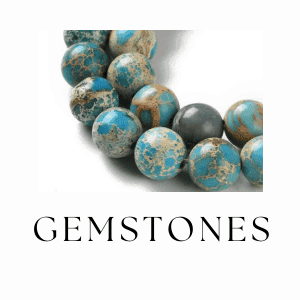
Every Gemstone Known to Man
The complete A–Z gemstone encyclopedia — origin, description and history for every precious and semi-precious stone. Written for beaders, jewellery makers and gem lovers across Australia.
Gemstones have shaped human civilisation. They have decorated the crowns of emperors, been carried into battle as talismans of invincibility, ground into pigments that coloured the Virgin Mary's robes in Renaissance paintings, and traded across continents millennia before currency existed. Each stone embedded in the Earth carries a story as old as the planet itself.
This encyclopedia covers every major gemstone known to humanity, arranged alphabetically for easy reference. For each stone you'll find its geological origin, a visual description and a rich cultural history. Where a stone is available as beads through Australia Beads, we've linked directly so you can bring it into your next creation.

Agate
Banded Agate · Moss Agate · Fire Agate
Description
A microcrystalline variety of quartz distinguished by its striking concentric or wavy banding. Colours span white, grey, red, orange, brown and blue — each layer formed by repeated silica deposition within volcanic cavities. Translucency varies from near-opaque to glowing translucent.
Origin
Found worldwide — Brazil, Uruguay, India, China, Australia and the USA. Named after the Achates River (now Dirillo) in Sicily, where ancient Greeks first sourced it.
History
Among humanity's oldest ornamental stones, agate artefacts date back to 3000 BCE. Ancient Egyptians used it for amulets; Greeks and Romans carved cameos from it. Medieval Europeans believed it could neutralise venom and bestow eloquence on its wearer.

Alexandrite
Alexandrite Chrysoberyl · Alexandrite Effect
Description
Famous for its dramatic colour-change phenomenon — green or teal in daylight, purplish-red under incandescent light. This effect is caused by chromium impurities absorbing light in a narrow band. Fine specimens rank among the world's most valuable gemstones per carat.
Origin
First discovered in the Ural Mountains of Russia in 1830. Significant deposits now exist in Brazil, Sri Lanka, Madagascar and East Africa.
History
Named in honour of Tsar Alexander II of Russia on his coming-of-age day. Its red-and-green duality mirrored Russia's imperial military colours, making it enormously fashionable. Original Ural alexandrites remain the most prized of all.

Amazonite
Amazon Stone · Green Feldspar
Description
A striking blue-green potassium feldspar, amazonite owes its vivid colour to trace amounts of lead and water within its crystal structure. Opaque to translucent, with natural white streaking that creates beautiful visual texture and a gentle schiller effect.
Origin
Colorado (USA), Brazil, Russia, Ethiopia, Madagascar and India. Despite its name, no significant deposits occur along the Amazon River.
History
Amazonite artefacts were found in Tutankhamun's tomb. Ancient Mesopotamians and pre-Columbian South Americans used it ornamentally. For centuries it was mistakenly believed to originate from the Amazon Basin, lending it an exotic mythology.
 In Stock
Amethyst
February Birthstone · Violet Quartz
Description
The most beloved variety of quartz, ranging from pale lilac to deep violet. Its purple hue derives from iron impurities and natural irradiation within the crystal. Available in stunning geodes, faceted gems and polished beads beloved by jewellery makers worldwide.
Origin
Brazil and Uruguay dominate global production, yielding enormous geode cathedrals. Also mined in Zambia (deep, vivid purple), Madagascar, Russia and India.
History
Ancient Greeks wore amethyst and carved drinking vessels from it, believing it prevented intoxication — the name means "not intoxicated" in Greek. In medieval Europe, bishops wore amethyst rings as symbols of spirituality. It was considered a cardinal gemstone equal to ruby and sapphire until massive Brazilian deposits democratised it in the 19th century.
 In Stock
Apatite
Blue Apatite · Paraíba Apatite
Description
A phosphate mineral occurring in an extraordinary spectrum of colours — neon blue, electric green, golden yellow, violet and colourless. Blue apatite is the most prized for its intense, almost tropical luminosity. Relatively soft (Mohs 5), it's best suited to earrings and pendants where impact is minimal.
Origin
Brazil, Mexico, Myanmar, India, Madagascar and Canada produce gem-quality apatite. The finest blue material originates from Brazil and Madagascar.
History
Named from the Greek "apatao" meaning "to deceive," as it was frequently mistaken for tourmaline, peridot and beryl. Despite widespread geological occurrence, faceted gem-quality apatite remained obscure to all but collectors until the late 20th century.

Aquamarine
March Birthstone · Santa Maria Aquamarine
Description
A blue to blue-green beryl coloured by iron impurities, aquamarine ranges from pale sky blue to deep ocean teal. The prized "Santa Maria" variety from Brazil commands premium prices for its saturated, vivid blue. Typically very clean and transparent, Mohs 7.5–8.
Origin
Brazil (Minas Gerais) dominates global supply. Notable deposits also in Nigeria, Zambia, Pakistan, Mozambique and Madagascar.
History
Ancient Romans believed aquamarine was sacred to Neptune and sailors carried it for protection at sea. Medieval Europeans used it to improve eyesight and reveal truth. One of the most celebrated aquamarines is the 110.5-carat Roosevelt Aquamarine, gifted to Eleanor Roosevelt by the Brazilian government in 1936.

Aventurine
Green Aventurine · Blue Aventurine
Description
A sparkling form of quartz characterised by aventurescence — a glittery metallic shimmer produced by tiny reflective mica inclusions. Most commonly green but also appears in orange, red, blue, yellow and grey. Long used as a jade substitute in East Asian decorative arts.
Origin
India (Mysore) is the primary source. Other deposits in Russia, Brazil, Austria, Tanzania and the USA.
History
The name derives from the Italian "a ventura" (by chance), referring to the accidental 18th-century discovery of aventurine glass. Tibetan statues have incorporated aventurine eyes for thousands of years. Indian artisans have carved it into figurines and jewellery for millennia.
 In Stock
Azurite
Chessylite · Azure Malachite
Description
A vivid deep-blue copper carbonate hydroxide, celebrated for one of the most intense natural blues in existence. Frequently occurs alongside malachite, forming spectacular blue-and-green specimens. Mohs 3.5–4, often stabilised for jewellery use.
Origin
Produced in copper-rich deposits worldwide — Morocco, Namibia, Australia (Broken Hill and Burra), China, Russia and Arizona, USA.
History
Ancient Egyptians and Aztecs ground azurite as a vivid blue pigment. Renaissance painters used it for ultramarine blues in religious masterworks. In China it was considered sacred. Remarkably, many old masters' blue skies turned green over centuries as azurite slowly converted to malachite through moisture exposure.

Beryl
Parent of Emerald, Aquamarine, Morganite, Heliodor
Description
A beryllium aluminium silicate producing some of Earth's finest gemstones. Pure beryl is colourless (goshenite); chromium creates emerald's green; iron yields aquamarine blue or heliodor yellow; manganese forms morganite's blush pink. Hardness 7.5–8 makes it very suitable for all jewellery types.
Origin
Found in granitic pegmatites and metamorphic rocks globally. Major sources in Colombia, Brazil, Russia, Pakistan, Afghanistan and Africa.
History
The Romans fashioned the first corrective lenses from polished beryl. Emperor Nero reportedly peered through a large emerald (beryl) to watch gladiatorial combat, using it as a colour filter. Beryl has been mined for at least 2,000 years continuously.

Bloodstone
Heliotrope · Martyr's Stone
Description
A dark green variety of chalcedony scattered with vivid red flecks of iron oxide, dramatically evoking drops of blood against forest green. A traditional March birthstone and one of the most historically loaded gemstones in existence.
Origin
India's Kathiawar peninsula produces the finest. Other sources include Brazil, China, Australia and the USA.
History
Medieval Christians called it the "martyr's stone," believing its red spots were Christ's blood fallen on jasper at the Crucifixion. Ancient Egyptians and Greeks used it in amulets. Medieval European healers considered it one of the most powerful healing stones, capable of stopping haemorrhages and curing blood diseases.

Blue Lace Agate
Variety of Banded Chalcedony
Description
A delicate pale blue to white banded chalcedony distinguished by its soft lacy patterns and translucent, cloud-like quality. Among the most popular beading stones for its serene, sky-like hues — perfect for minimalist and boho jewellery styles alike.
Origin
Originally discovered in Namibia in the 1960s. Small deposits also exist in Romania and the USA.
History
Introduced to gem collectors by George Swanson, who discovered it in Namibia and recognised its ornamental potential. It quickly became a staple of crystal healing and jewellery making for its gentle aesthetic and calming associations.

Carnelian
Cornelian · Red Agate · Sardius
Description
A reddish-orange to deep red translucent chalcedony coloured by iron oxide. Its warm fire-like transparency and smooth waxy lustre make it one of the most universally appealing gemstones for beadwork. Heat treatment from India intensifies the colour of commercial stones.
Origin
India (Gujarat) is the premier source. Also found in Brazil, Uruguay, Siberia and Germany.
History
One of the oldest gemstones used continuously by humanity. Egyptian dead were buried with carnelian for afterlife protection. Romans engraved it as signet seals because wax doesn't stick to it. Napoleon carried a carnelian seal looted from Egypt. Islamic tradition holds it especially sacred — the Prophet Mohammed wore a carnelian ring.
 In Stock
Charoite
Stone of Transformation · Siberian Purple
Description
A unique lilac-to-deep-purple silicate mineral with swirling, fibrous chatoyant patterns unlike any other stone on Earth. The interlocking needle-like crystals create a spectacular silky lustre that shimmers as the stone is rotated. Found in exactly one place on the planet.
Origin
Found exclusively along the Chara River in Siberia, Russia — giving it its name. The deposit was only discovered in the 1940s and formally described in 1978.
History
One of the newest named gemstones, officially described in 1978 by V.P. Rogova and colleagues. Despite its recent discovery, charoite has rapidly become one of the most collectable and distinctive of all semi-precious stones, prized for its one-of-a-kind swirling purple patterns and rarity.

Chrysoprase
Australian Jade · Apple Green Chalcedony
Description
The finest and most valuable chalcedony variety, chrysoprase is a vivid apple-to-mint green coloured by nickel silicate inclusions. Top-grade material is translucent with an intense, saturated green that rivals fine jade. Australia is a major producer of world-class material.
Origin
Australia (Queensland and Western Australia) produces the world's finest. Other sources include Poland (historical), Brazil, Tanzania and the USA.
History
Mentioned by Pliny the Elder and prized throughout antiquity. Alexander the Great reportedly wore chrysoprase in his belt for invincibility. Medieval Europeans believed it made thieves invisible. Australia's discovery of major deposits in the 20th century brought chrysoprase to global gem markets at scale.

Citrine
November Birthstone (alternate) · Merchant's Stone
Description
A transparent yellow to orange-brown quartz, citrine's warm tones range from pale lemon through golden honey to deep amber. The world's most commercially important yellow gemstone. Natural citrine is far rarer than heat-treated amethyst, which produces similar colours and makes up most market supply.
Origin
Brazil (Rio Grande do Sul) dominates production. Also found in Bolivia, Madagascar, Russia and Scotland.
History
Known as the "merchant's stone" for centuries, carried to attract prosperity. The Romans fashioned it into cabochons and intaglios. During the 1930s–50s Art Deco era, large faceted citrines became hugely fashionable in Hollywood jewellery. Scottish Highland dress has long incorporated large citrine brooches as traditional ornamentation.
 In Stock
Coral
Precious Coral · Corallium Rubrum
Description
An organic gemstone formed by living marine polyps secreting calcium carbonate skeletons. Ranges from white and pink through vivid red and ox-blood red (the most prized). Takes a silky polish and has been carved into beads, cameos and figurines for millennia.
Origin
Mediterranean Sea (Italy, Spain, Algeria) and Pacific (Japan, Taiwan) are traditional sources. Trade in wild coral is now strictly regulated under CITES.
History
Among the oldest known ornamental materials — found in Palaeolithic cave sites in Europe. Ancient Romans hung coral around children's necks for protection. In Hindu tradition, red coral is sacred to Mars. Tibetan and Nepalese jewellery uses it as a primary ornamental stone alongside turquoise. Italian coral carving from Naples and Torre del Greco has been a celebrated art form since the Renaissance.

Diamond
April Birthstone · King of Gems · Pure Carbon
Description
The hardest natural substance on Earth (Mohs 10), diamond is pure carbon crystallised under extreme heat and pressure 100–200 km below the surface. Its extraordinary brilliance comes from a very high refractive index; its fire from strong dispersion. Evaluated by the 4Cs: cut, colour, clarity and carat.
Origin
Delivered to the surface by volcanic kimberlite pipes. Major producers: Russia (Alrosa), Botswana (Debswana), Canada, Angola and Australia — the now-closed Argyle mine in Western Australia was the world's leading source of rare pink diamonds.
History
First mined in India's legendary Golconda region, whose stones — including the Hope Diamond and Koh-i-Noor — remain the most storied in history. Ancient Hindus considered it sacred to Indra, king of gods. The modern engagement ring tradition was cemented by De Beers' 1947 campaign — widely considered the most effective advertising slogan in history: "A Diamond is Forever."

Dumortierite
Blue Quartz (when included in quartz)
Description
A deep blue to violet-blue orthorhombic silicate, often found as inclusions within quartz creating rich "blue quartz" cabochons. Its distinctive violet-blue makes it a popular lapidary material for beads and carvings with a distinctive inky hue.
Origin
Brazil, France (first described), Mozambique, Namibia, Madagascar, Norway, Poland and the USA.
History
Described and named in 1881 after French palaeontologist Eugène Dumortier. Historically valued for making high-quality porcelain and refractory ceramics before its gem potential was recognised. Its popularity as a lapidary stone has grown steadily through the 20th and 21st centuries.

Emerald
May Birthstone · Green Beryl
Description
The most precious of all green gemstones — a chromium-coloured beryl displaying vivid "emerald green." Internal inclusions called "jardin" (French for garden) are considered part of the stone's personality. Colombian emeralds from the Muzo and Chivor mines represent the world's finest, with a warm, slightly bluish-green hue and extraordinary depth.
Origin
Colombia (Muzo and Chivor mines) produces the world's finest. Other sources: Zambia (deep, slightly bluish green), Brazil, Zimbabwe, Afghanistan, Pakistan and Ethiopia.
History
Mined in Egypt since at least 1500 BCE — Cleopatra's emerald mines in the Eastern Desert are among the oldest in recorded history. Aztecs and Incas considered emeralds sacred. Spanish conquistadors seized enormous quantities from South America. The 217.80-carat Mughal Emerald, inscribed with Islamic prayers, sold at auction in 2001 for $2.2 million.

Fluorite
Rainbow Fluorite · Fluorspar · Blue John (UK variety)
Description
One of the world's most colourful minerals, occurring in virtually every colour — purple, green, yellow, blue, pink, colourless — and spectacular multi-colour banding. Defines Mohs hardness 4 and was the first mineral found to exhibit fluorescence under UV light, giving the phenomenon its name.
Origin
Worldwide. Major gem-quality sources in China, Mexico, South Africa, Spain, Namibia and the UK (Derbyshire Blue John variety).
History
Ancient Egyptians and Romans carved it into luxury vessels and amulets. Romans believed fluorite vessels prevented drunkenness. Derbyshire's "Blue John" fluorite has been mined in England for 300+ years and is protected as a national heritage mineral. Fluorite was also pivotal to atomic energy development as the primary source of fluorine.

Garnet
January Birthstone · Almandine · Pyrope · Tsavorite · Demantoid
Description
Not a single mineral but a diverse group of silicate minerals sharing a cubic crystal structure. Garnet occurs in almost every colour — the rare green demantoid and vivid tsavorite are the most valuable; deep red pyrope and almandine the most recognised. Hardness 6.5–7.5. Demantoid has higher dispersion than diamond.
Origin
Found worldwide. Tsavorite from Kenya and Tanzania; demantoid from Russia and Namibia; spessartine from Nigeria and Mozambique; rhodolite from North Carolina, USA.
History
One of the oldest gemstones in continuous use — found in Egyptian jewellery from 3100 BCE. Anglo-Saxons set red garnets in gold sword hilts and brooches. Medieval travellers carried garnet for protection on journeys. Bohemian pyrope garnet jewellery was the height of fashion in 19th-century Europe.
 In Stock
Goldstone
Aventurine Glass · Stellaria · Monk's Gold
Description
A glittering man-made glass containing thousands of tiny copper crystal platelets that create a stunning galaxy-like sparkle throughout. Brown-red goldstone is the classic form; blue goldstone (cobalt or manganese) and green goldstone are also produced. Universally beloved in beading for its dramatic visual impact.
Origin
Historically produced in Murano, Venice. Now primarily manufactured in China. Possible Persian origins pre-date the Venetian tradition.
History
Legend credits Venetian Miotti family monks who accidentally spilled copper filings into molten glass. The Venetian Republic granted the Miotti family an exclusive licence from the Doge to produce it, jealously guarding the formula for generations. Its accessible price point and dazzling appearance have made it one of the most enduringly popular beading materials in the world.
 In Stock
Hematite
Iron Rose · Specularite · Blood Stone (historical)
Description
An iron oxide mineral prized for its striking metallic silver-grey lustre when polished. Despite looking silver, it leaves a distinctive rust-red streak. The densest common ornamental stone, hematite is cool to the touch and takes an exceptional mirror-bright polish beloved in jewellery.
Origin
Found globally. Brazil produces the finest quality. Also from Australia (significant deposits), Canada, China, Venezuela and the UK (Cumberland).
History
Ancient Egyptians and Greeks ground red ochre (powdered hematite) for cosmetics. The name is from the Greek "haima" — blood. Roman legionaries rubbed hematite on their bodies before battle for supernatural protection. Native Americans used it in war paint rituals. In Victorian England, polished hematite jewellery was fashionable mourning wear.
 In Stock
Howlite
White Turquoise (dyed) · White Buffalo (trade)
Description
A white to off-white calcium borosilicate mineral distinguished by its characteristic grey or black veining on a white base. Highly porous and responsive to dye, it is widely coloured to simulate turquoise, coral and lapis. Natural white howlite is striking in its own right — extremely popular in modern minimalist and bohemian jewellery.
Origin
Primarily Nova Scotia, Canada (where first discovered). Also in California, Mexico, Turkey and Germany.
History
Discovered in 1868 by Nova Scotian mineralogist Henry How, alerted by local gypsum miners who found it a nuisance when mining. Long considered an industrial curiosity, howlite found its commercial destiny when the craft jewellery movement discovered its capacity to absorb dye uniformly. Today it is one of the highest-volume beading stones in the world.

Iolite
Water Sapphire · Viking Compass Stone · Cordierite
Description
A violet-blue silicate exhibiting remarkable strong pleochroism — it appears blue-violet from one direction, yellow-grey from another and near-colourless from a third. This extraordinary optical property made it historically invaluable to Viking navigators. Often called a budget alternative to tanzanite and sapphire.
Origin
India, Sri Lanka, Mozambique, Zimbabwe, Brazil, Canada and Norway.
History
Viking navigators used thin slices of iolite as a polarising light filter to locate the sun on overcast days — possibly the world's oldest documented navigational instrument. The pleochroic effect allowed determination of the sun's position even when below the horizon. This remarkable use may have enabled Viking oceanic navigation centuries before the magnetic compass reached Europe.
 In Stock
Jade
Jadeite (precious) · Nephrite (classic) · Imperial Jade
Description
Two distinct minerals share the jade name: jadeite (harder, rarer, more vivid — including the coveted Imperial Jade) and nephrite (tougher, more common). Imperial Jade is a translucent, vivid emerald-green jadeite from Myanmar and the most valuable jade by weight. Nephrite ranges from spinach-green to creamy white ("mutton fat jade").
Origin
Myanmar produces the world's finest jadeite. Nephrite sources include Canada (British Columbia), New Zealand (pounamu), China, Russia and Australia.
History
In China, jade has been revered above all stones for 7,000+ years — considered the stone of heaven, virtue and immortality. Ancient Mesoamerican civilisations valued jade above gold. New Zealand Māori carve pounamu into hei-tiki pendants as sacred heirlooms. Han dynasty Chinese royalty were buried in complete jade suits. No other gemstone has been as continuously and intensely venerated across so many cultures.
 In Stock
Jasper
Imperial · Fancy · Ocean · Mookaite · Kambaba · Dalmatian
Description
An opaque, impure silica variety whose extraordinary range of colours and patterns comes from mineral inclusions, cementing minerals and organic matter. From the spotted Dalmatian jasper to swirling Mookaite, oceanic Ocean Jasper and the orbital patterns of orbicular jasper — no two pieces in the world are identical.
Origin
Found globally. Mookaite is uniquely Australian (Western Australia); Imperial jasper from Mexico; Kambaba from Madagascar and South Africa; Ocean Jasper from Madagascar only.
History
A premier gemstone of the ancient world — used in seals, amulets, vases and weapons from Egypt to Assyria. Listed in the Hebrew high priest's breastplate. Ancient Egyptians carved green jasper into agricultural amulets for rainfall. Native Americans used jasper for tools and arrowheads long before European contact. Australia's Mookaite is a source of proud national gem heritage.

Kunzite
Pink Spodumene · Evening Stone
Description
A transparent, pastel pink to lilac-pink gem variety of spodumene, coloured by manganese. Strongly pleochroic and prone to fading in prolonged sunlight (hence "evening stone"). Large crystals are common, making for impressive statement gems. Mohs 6.5–7.
Origin
Afghanistan, Pakistan and Brazil are the primary sources. Also USA (California), Madagascar and Myanmar.
History
Named after pioneering American gemmologist George Frederick Kunz, who first described it in 1902. A 47-carat kunzite ring was among Jackie Kennedy's cherished possessions. Being a modern discovery, kunzite lacks ancient lore but has rapidly become a romantic jewellery staple for its soft, feminine hues.

Kyanite
Disthene · Blue Spar
Description
A distinctly bladed blue silicate whose hardness varies by direction (4.5 along crystal length, 6.5 across) — a unique property called anisotropy. Gem quality kyanite is a beautiful sapphire-blue. Also occurs in green, orange, black and yellow. Typically untreated — no heat or clarity enhancements required.
Origin
Nepal, Brazil, India and Kenya. Also Russia, Austria, Switzerland and the USA.
History
From the Greek "kyanos" meaning blue. Long an industrial mineral (porcelain, refractory ceramics, electrical insulators) before its gem potential was fully appreciated. Increasingly sought in contemporary jewellery for its natural, enhancement-free beauty and distinctive structural character.

Labradorite
Spectrolite (Finland) · Rainbow Moonstone (trade)
Description
Famous for its breathtaking labradorescence — intense iridescent flashes of blue, green, gold, orange and violet that appear to shimmer beneath the surface as the stone is turned. Produced by light interference between twinned crystal layers. Finnish spectrolite displays the full colour spectrum simultaneously.
Origin
First described from Paul's Island, Labrador, Canada. Major gem sources in Madagascar (most of global supply), Finland (spectrolite), Russia and Mexico.
History
Inuit legend holds that a warrior struck the Labrador rocks to free the Northern Lights trapped within — and some light remained in the stones forever. Discovered by Moravian missionaries in 1770. Finnish spectrolite, discovered in the 1940s, is the most prized variety. Labradorite is now among the most universally loved beading stones for its otherworldly visual drama.
 In Stock
Lapis Lazuli
Lapis · Stone of Heaven · Lazurite Rock
Description
A deep-blue metamorphic rock composed primarily of lazurite, calcite and pyrite. The finest displays a uniform, intense ultramarine blue with subtle gold pyrite flecks. Lower grades show white calcite patches. Among the most historically significant gemstones in all of human history.
Origin
The Sar-e-Sang mines in Afghanistan's Badakhshan province have been the world's dominant source for over 6,000 years. Also found at Lake Baikal (Russia) and in Chile.
History
Artefacts from Pakistan's Mehrgarh date to 7000 BCE. Ground into ultramarine pigment, it coloured the Virgin Mary's robes in Renaissance paintings — the most expensive pigment in pre-modern history. Tutankhamun's death mask is inlaid with lapis. Sumerian jewellery from 4500 BCE uses it extensively. The word "azure" derives from its Persian name "lazhward." No stone has influenced Western art history more profoundly.
 In Stock
Malachite
Green Copper Ore · Peacock Stone
Description
A vivid green copper carbonate hydroxide celebrated for its concentric swirling bands of light and dark green — no two pieces alike. Forms in botryoidal (grape-cluster) masses; sliced and polished to reveal dramatic growth rings. A perennial favourite for beads, cabochons and carvings worldwide.
Origin
The Democratic Republic of Congo (Katanga) produces the world's finest. Also from Zambia, Russia, Australia (Burra, SA), Namibia, Mexico and Arizona, USA.
History
Mined in Egypt since at least 4000 BCE as a copper ore and green eye shadow ("kohl green"). The Winter Palace in St Petersburg features a magnificent Malachite Room — testament to the Romanov tsars' obsession with it. Catherine the Great and Tsar Nicholas II both commissioned extraordinary malachite objects. Carved into elaborate vases, urns and columns, malachite became the ultimate expression of Russian imperial opulence.

Morganite
Pink Beryl · Rose Beryl · Vorobyevite
Description
The pink to peach-pink beryl, coloured by manganese. Its warm blush-to-salmon hues have made it one of the most fashionable gemstones of the 21st century — especially in rose gold engagement ring settings. Hard (Mohs 7.5–8), durable, and typically free of inclusions.
Origin
Brazil is the primary source; Madagascar yields exceptional large crystals. Also from the USA (California), Afghanistan and Mozambique.
History
Named by gemmologist George Frederick Kunz in 1910 after financier J.P. Morgan — a significant gem collector and benefactor of New York's American Museum of Natural History. Long overlooked in favour of pink tourmaline, morganite exploded in popularity from 2010 when rose gold jewellery became a global fashion force.
 In Stock
Moonstone
June Birthstone · Rainbow Moonstone · Adularescence
Description
A potassium feldspar celebrated for its floating blue-white shimmer — called adularescence — produced by light scattering between alternating albite and orthoclase crystal layers. The finest Sri Lankan "blue moonstone" shows a billowing blue sheen hovering just above the stone's surface like trapped moonlight.
Origin
Sri Lanka produces the finest blue moonstone. India supplies most commercial "rainbow moonstone" (technically labradorite). Also from Myanmar, Madagascar, Australia and the USA.
History
Ancient Romans and Greeks believed moonstone was solidified moonbeams containing a visible deity within. Hindu mythology considers it sacred and formed from moonlight. Art Nouveau jewellery master René Lalique made it a signature material. Florida designated it the official state gemstone to honour the Apollo missions — despite no moonstone deposits existing in Florida.

Nuummite
Sorcerer's Stone · World's Oldest Gemstone
Description
One of Earth's oldest gemstones at approximately 3 billion years old, nuummite is a metamorphic rock composed of gedrite and anthophyllite amphiboles. Its dark, almost black surface is ignited by brilliant flashes of gold, copper, red, green and blue — a phenomenon called schiller. Each stone resembles a miniature captured cosmos.
Origin
Found almost exclusively near Nuuk, southwest Greenland. Extremely rare and only accessible during summer months when the Arctic terrain is navigable.
History
Used by indigenous Inuit people of Greenland for thousands of years as a protective talisman. Modern gem use began after geologists formally documented it in the 1980s. Its extraordinary age — formed before complex life existed on Earth — makes it among the most metaphysically powerful stones in crystal healing traditions worldwide.

Obsidian
Volcanic Glass · Apache Tears · Snowflake Obsidian
Description
A naturally occurring volcanic glass formed when silica-rich lava cools rapidly. Deep black and glassy, it fractures conchoidally (in smooth curved shells) to produce razor-sharp edges sharper than surgical steel. Varieties include mahogany obsidian (brown streaks), snowflake obsidian (white spherulite patterns) and rainbow obsidian (iridescent sheen).
Origin
Found wherever there is or was volcanic activity — Mexico, USA (Oregon, California), Iceland, Japan, Turkey and Armenia (one of the ancient trade routes' most important commodities).
History
Obsidian tools represent some of the earliest known human technology, used for knives, arrowheads and surgical blades since the Palaeolithic. Ancient trade routes carrying obsidian across continents have been archaeologically mapped. Aztec priests used obsidian mirrors for divination and ritual sacrifice. Aztec deity Tezcatlipoca was "Lord of the Smoking Mirror" — an obsidian mirror. Obsidian scalpels are still used in some modern eye surgeries for their unrivalled edge.
 In Stock
Onyx
Black Onyx · Banded Onyx · Sardonyx
Description
A banded variety of chalcedony where the bands are straight and parallel (unlike agate's curved bands). Black onyx — the most commercially common — is typically dyed from grey chalcedony. Natural banded onyx shows white and black layers; sardonyx combines red-brown sard with white bands. Takes an exceptional polish and is a classic jewellery staple.
Origin
Brazil, India, Uruguay and the USA are major sources. Extensive dyeing and treatment of grey chalcedony to produce black onyx has been standard practice since ancient times.
History
Roman soldiers wore onyx engraved with Mars, god of war, for courage. Ancient Egyptians and Persians carved it into cameos and intaglio seals. In medieval Europe, onyx was paradoxically associated both with protection and with bad luck — believed to cause nightmares and discord if worn at night. Victorian mourning jewellery made it perennially fashionable as a symbol of dignified grief.

Pearl
June Birthstone · Akoya · South Sea · Tahitian · Freshwater
Description
The only gemstone created by a living organism, pearls form when a mollusc secretes nacre around an irritant. Their luminous quality — called orient — results from light diffracting through hundreds of concentric nacre layers. Natural wild pearls are exceptionally rare today; virtually all commercial pearls are cultured.
Origin
South Sea pearls (largest) from Australia, Indonesia and the Philippines. Tahitian black pearls from French Polynesia. Akoya pearls from Japan. Freshwater pearls predominantly from China.
History
The oldest known jewel — pearl necklaces found in Persian royal tombs date to 520 BCE. In ancient Rome, only the highest social ranks could legally wear pearls. Cleopatra famously dissolved a pearl in vinegar and drank it to win a wager about hosting the most expensive banquet in history. Australia's South Sea pearl industry is world-renowned, producing the largest and finest cultured pearls on Earth.

Peridot
August Birthstone · Gem of the Sun · Olivine
Description
One of the few gemstones existing in only one colour — a distinctive lime to olive green determined by iron content. Unlike most gems, peridot forms in Earth's mantle and reaches the surface through volcanism. Extraordinarily, it has been found in pallasite meteorites — making it a true cosmic gemstone.
Origin
Pakistan (Kohistan, finest quality), Myanmar, the historic Zabargad island (Red Sea, Egypt), Arizona (Navajo lands), China and Australia.
History
Ancient Egyptians called it the "gem of the sun" and mined Zabargad island under heavily guarded secrecy. Many of Cleopatra's famous "emeralds" were likely peridot. Medieval European Crusaders brought it back from the Holy Land and set it in cathedral treasures. The 200-carat gems on Cologne Cathedral's Three Kings shrine were long believed to be emeralds — they are peridot.

Prehnite
Grape Jade (trade) · Stone of Prophecy
Description
A pale, translucent yellow-green to apple-green silicate mineral with an oily to waxy lustre. Often occurs in botryoidal (grape-cluster) formations. Fine specimens are beautifully translucent with a soft inner glow. Frequently contains black tourmaline or epidote inclusions that create dramatic internal landscapes.
Origin
South Africa (first described), Australia (striking specimens from Halls Creek WA), China, Mali, Scotland and the USA.
History
Named after Colonel Hendrik von Prehn, who brought specimens from the Cape Colony to Europe around 1774 — making prehnite the first mineral named after a specific person. South African Xhosa shamans reportedly used it for divination and prophetic dreaming, earning it the moniker "stone of prophecy." Its jade-like appearance drives strong demand in Asian markets.

Pyrite
Fool's Gold · Iron Pyrite · Marcasite (cut form)
Description
An iron sulfide mineral celebrated for its brassy gold metallic lustre. Crystals form perfect cubes, octahedra and pyritohedra. Cut and polished as "marcasite" in Victorian jewellery, it displays metallic fire unlike any other stone. Despite its nickname, fool's gold is a fascinating gem in its own right.
Origin
Worldwide. Exceptional crystals from Navajún, Spain; Peru; Italy and the USA.
History
Used by pre-Columbian Americans to create polished scrying mirrors. Aztec priests made pyrite mosaic mirrors for ritual divination. The Romans used it as a fire-starter (Greek "pyr" = fire). Victorian jewellery used cut pyrite as "marcasite" — a fashion that persists powerfully in vintage and retro jewellery today.

Rhodonite
Rose Stone · Manganese Silicate
Description
A rose-pink to deep red manganese silicate dramatically veined with black manganese oxide. The stark contrast between vivid pink and jet-black veining creates striking organic patterns. Rhodochrosite is a more translucent, closely related pink stone.
Origin
Russia's Ural Mountains (classic source), Australia, Sweden, Brazil, USA and Peru.
History
From the Greek "rhodon" — rose. Revered by Russian tsars who used it for sarcophagi, columns and grand ornamental objects. The Trans-Siberian Railway's Ekaterinburg station was decorated with rhodonite. Russia designated it the national stone in 1913. Today it is also the official state gem of Massachusetts, USA.
 In Stock
Rose Quartz
Love Stone · Star Rose Quartz
Description
A translucent to transparent pale pink quartz coloured by trace titanium, iron and manganese — and by microscopic fibrous inclusions that produce a soft asterism (star effect) in cabochon cuts. Ranging from barely-there blush to deep strawberry pink, it is the world's most universally loved pink gemstone.
Origin
Brazil (Minas Gerais) dominates. Also Madagascar, South Africa, Namibia, India and the USA.
History
Rose quartz facial rollers in Egyptian tombs confirm that ancient Egyptians used it for beauty treatments — a practice resurgent with extraordinary force in 21st-century wellness culture. Ancient Romans used it for wax seals. Across cultures from Tibetan to Native American, rose quartz has been universally associated with love, compassion and emotional healing — now the defining crystal of the global wellness movement.

Ruby
July Birthstone · King of Precious Stones · Red Corundum
Description
The red variety of corundum (aluminium oxide), coloured by chromium. The finest "pigeon's blood" rubies from Myanmar are a vivid, slightly bluish-red with strong fluorescence under UV. Fine rubies command higher per-carat prices than diamonds. Mohs 9 — the second hardest natural gemstone after diamond.
Origin
Myanmar's Mogok Valley produces legendary pigeon's blood rubies. Mozambique has emerged as a major modern source. Also Thailand, Sri Lanka, Cambodia, Afghanistan and Greenland.
History
In ancient India, the Sanskrit "ratnaraj" means "king of precious stones." Ancient Burmese warriors inserted rubies under their skin before battle for invincibility. Medieval Europeans believed rubies could predict danger by darkening in colour. The famous "Black Prince's Ruby" in Britain's Imperial State Crown is actually a spinel — underlining how frequently ruby has been confused with other red gems throughout history.

Sapphire
September Birthstone · Padparadscha · All Non-Red Corundum
Description
All gem-quality corundum except red (ruby) is called sapphire. While most famous in vivid cornflower blue (from iron and titanium), sapphire occurs in pink, yellow, orange, purple, green and colourless — and the extraordinary padparadscha (salmon-pink to orange-pink). Mohs 9, exceptionally hard and durable.
Origin
Kashmir produced the legendary velvety "cornflower blue" (now depleted). Myanmar, Sri Lanka (padparadscha and fine blues), Madagascar and Australia (dark blue) are major sources.
History
Ancient Persians believed the sky was blue because Earth rested on a giant sapphire. Medieval clergy wore it as a symbol of heaven. Greeks wore it for wisdom when consulting the Oracle at Delphi. Princess Diana's 18-carat oval Kashmir sapphire engagement ring — now worn by Catherine, Princess of Wales — is the world's most famous sapphire jewel.

Selenite
Satin Spar · Desert Rose · Gypsum Flower
Description
A crystalline form of gypsum with a silky, pearlescent lustre. Satin spar is its fibrous variety displaying beautiful chatoyancy. Too soft for conventional jewellery (Mohs 2), it is widely used in metaphysical and decorative contexts. Mexico's Naica cave contains selenite crystals reaching 12 metres in length — among the largest crystals ever found.
Origin
Mexico (Naica mine — extraordinary giant crystals), Morocco, Russia, Australia, Poland, Greece and the USA.
History
Named after Selene, Greek goddess of the moon. Used in ancient windows before glass became common — Roman temples and early medieval churches in Britain used selenite panes for translucent light. The ancient city of Teotihuacán used selenite mirrors for scrying. Now among the most popular crystals in modern wellness spaces for energy cleansing.
 In Stock
Serpentine
New Jade (trade) · Williamsite · Bowenite
Description
A group of hydrated magnesium silicate minerals ranging from yellow-green through apple green to deep forest green. Often mottled or veined with black, yellow or white. Fine translucent green varieties closely resemble jade, giving rise to the trade name "new jade." Takes an excellent polish.
Origin
Found worldwide in metamorphic settings. Notable sources in China, Afghanistan, New Zealand, the USA (California), India and South Africa.
History
Used by ancient Greeks, Romans and Native Americans for ornamental and functional objects. Pre-Columbian Mesoamerican cultures used serpentine extensively as a jade substitute for masks, figurines and offerings. In China, some historical "jade" artefacts in museum collections have been reidentified as high-quality serpentine — testament to its remarkable jade-like appearance.

Spinel
August Birthstone (added 2016) · Balas Ruby (historical)
Description
A magnesium aluminium oxide in rich red, hot pink, vivid orange (flame spinel), brilliant cobalt blue and violet. For centuries confused with ruby — many of history's greatest "rubies" proved to be spinel on scientific examination. Fine red spinels rival top rubies in colour intensity and brilliance.
Origin
Myanmar's Mogok Valley (finest reds alongside ruby), Tajikistan, Sri Lanka, Mahenge Tanzania (famous hot pink and orange), Vietnam and Madagascar.
History
The "Black Prince's Ruby" in Britain's Crown Jewels is a spinel. So are multiple stones in the Russian and Iranian crown jewels. For centuries these were all considered rubies. Spinel was finally correctly identified in 1587. Added as an August birthstone by the American Gem Trade Association in 2016 — long overdue recognition for one of the world's most beautiful gems.

Sunstone
Heliolite · Oregon Sunstone · Gold Sandstone
Description
A feldspar exhibiting aventurescence — brilliant, glittery sparkle caused by tiny hematite or copper platelets reflecting light. Colours from pale yellow to deep orange, red and green. Oregon sunstone is unique as its sparkle derives from native copper rather than iron, producing extraordinary colour-change and pleochroism.
Origin
Oregon, USA (rare gem-quality copper sunstones), Norway, India, Canada and Australia.
History
Viking legend connects sunstone to their "sólarsteinn" navigation stone. Native Americans of the Pacific Northwest used Oregon sunstone in trade and ceremony for millennia before European contact. Oregon designated it the official state gemstone in 1987.

Tanzanite
December Birthstone (2002) · Blue-Violet Zoisite
Description
A blue to violet zoisite displaying exceptional pleochroism — blue, violet and burgundy-red in different directions. Heat treatment converts its naturally reddish-brown colour to the coveted blue-violet. Found in only one place on Earth: a 7 km² zone in Tanzania. Geologists predict commercially viable supply may be exhausted within decades.
Origin
Found exclusively in the Merelani Hills near Arusha, Tanzania. One of the rarest gemstone localities on Earth.
History
Discovered in 1967 by Maasai tribesman Ali Juuyawatu. Tiffany & Co. named it tanzanite and marketed it as "found in only two places — Tanzania and Tiffany's." The most rapidly accepted new gemstone in history. Tanzania has since banned rough tanzanite exports to develop a local cutting industry, adding national economic significance to its remarkable story.

Tiger's Eye
Bull's Eye (red) · Hawk's Eye (blue) · Cat's Eye Quartz
Description
A golden to honey-brown chatoyant quartz displaying a shifting silky band of light — chatoyancy — produced by parallel fibres of crocidolite asbestos replaced by quartz and iron oxide. The light band moves across the stone as it is rotated, vividly mimicking a feline eye. Hawk's eye (blue) is the unoxidised variety; bull's eye (red) is heat-treated.
Origin
South Africa (Northern Cape) is the primary source. Also Australia, India, Burma, USA and Namibia.
History
Ancient Egyptians used tiger's eye for the divine eyes of their deity statues. Roman soldiers carried it into battle for protection. In the Far East it was carried as a talisman against the evil eye. Its extraordinary optical effect has made it one of the most consistently popular cabochon and bead stones in jewellery making through all eras and cultures.

Topaz
November Birthstone · Imperial Topaz · Blue Topaz · Mystic Topaz
Description
A fluorine-bearing silicate in a spectacular range of colours. Pure topaz is colourless; impurities create blue, yellow, orange, pink, red and brown. "Imperial topaz" — a warm orange-gold to pink-orange from Brazil — is the most prized and valuable. Blue topaz (typically irradiation-treated) dominates the commercial market by volume.
Origin
Brazil (Ouro Preto — finest Imperial topaz). Large blue topaz from Pakistan, Russia, Australia and Nigeria. The Ural Mountains' historical pink-blue topaz was once considered more valuable than diamond.
History
Ancient Greeks believed topaz could make its wearer invisible and increase physical strength. Medieval Europeans thought it could cure madness. The 1680-carat "Braganza Diamond" in the Portuguese Crown is almost certainly a colourless topaz. The word may derive from Topazos island in the Red Sea (now Zabargad — actually the source of peridot), reflecting ancient gem-naming confusion.
 In Stock
Tourmaline
October Birthstone · Paraíba · Rubellite · Indicolite · Watermelon · Chrome
Description
Tourmaline offers the widest colour range of any gemstone group — occurring in virtually every colour, often within a single crystal (watermelon: green rind, pink core). Paraíba tourmaline from Brazil glows with electrifying neon blue-green caused by copper and manganese, and is among the world's most valuable gems per carat, rivalling fine ruby and emerald.
Origin
Brazil (Paraíba, Minas Gerais), Afghanistan, Nigeria, Mozambique, Tanzania, Sri Lanka, Madagascar and the USA (Maine, California).
History
Dutch traders brought tourmaline to Europe from Sri Lanka in the early 1700s, unable to classify it and calling it "turmali" (mixed stone). China's Empress Dowager Cixi was obsessed with pink tourmaline, importing vast quantities from California to carve into snuff bottles and jewellery. Paraíba tourmaline, discovered in 1987, caused a sensation for its unmatched neon luminosity.
 In Stock
Turquoise
December Birthstone · Persian Turquoise · Fallen Sky Stone
Description
A hydrated copper aluminium phosphate, prized for its sky blue to blue-green colour. The finest "Persian blue" is vivid and uniform; most material contains dark matrix veins that can enhance appeal. One of the first gemstones mined by humanity — and still universally loved 8,000 years after its discovery.
Origin
Iran (finest Persian blue, Nishapur) remains the benchmark. USA (Arizona, Nevada) is the largest producer by volume. Also China, Tibet, Mexico and Australia.
History
Mined in Egypt's Sinai since at least 6000 BCE — among the oldest continuous mining operations in human history. Adorns Tutankhamun's funeral mask. Ancient Persians wore it around their necks as protection from unnatural death. Aztecs covered ceremonial objects in turquoise mosaic. Navajo people call it "the fallen sky stone" and it remains central to Southwestern American jewellery. Tibet's traditional jewellery uses it alongside coral as the two primary ornamental stones.

Unakite
Epidosite · Unakite Jasper (trade)
Description
A mottled metamorphic rock of pink orthoclase feldspar, green epidote and colourless quartz. Its instantly recognisable olive-green and salmon-pink patterning is unique in the mineral world. Takes a good polish and is prized for cabochons, beads and carvings in earthy, autumnal palettes.
Origin
First described from the Unaka Mountains of North Carolina and Tennessee, USA. Also found in Virginia, South Africa, Sierra Leone and Brazil.
History
Named after the Unaka Mountains. Used by Native Americans of the Appalachian region for tools and ornaments. Popularised during the 20th-century lapidary movement, unakite is now a beloved beadwork stone for its distinctive earthy colourway and the way it pairs naturally with wood and leather in bohemian designs.

Variscite
Utahlite · Amatrice
Description
A green hydrated aluminium phosphate often mistaken for turquoise, but distinctly more vivid green (apple to mint) rather than blue-green. Fine Utah material displays exceptional apple-green with white matrix veining that is visually distinct from any other stone.
Origin
Utah, USA (premier gem quality). Also Germany (first described — Variscia region), Spain, Czech Republic and Australia.
History
First described in 1837. Long sold as turquoise. Native American jewellers of the Southwest used Utah variscite as a turquoise substitute for generations. Its distinct green identity was only broadly recognised in the 20th century, finding its market among collectors and jewellers seeking a true apple-green stone.

Vesuvianite
Idocrase · Californite (jade-like variety) · Cyprine (blue)
Description
A complex calcium aluminium silicate in yellow, green, brown, blue and purple. The opaque green "californite" closely resembles jade and is carved into ornamental objects; transparent faceted vesuvianite is a collector's gem. Blue cuprian vesuvianite (cyprine) is among the rarest natural blue gems on Earth.
Origin
First found in lavas of Mount Vesuvius. Gem quality from Italy, Canada, Russia, Pakistan, USA (California) and Kenya.
History
Described from Monte Somma, Vesuvius in 1795. Californite was used by Native Californians as a jade substitute for tools and ornaments. Its transparent varieties were favoured by Victorian gem cutters before largely falling from fashion. Modern collector interest has created renewed appreciation for this characterful, diverse mineral group.

Wulfenite
Yellow Lead Ore · Arizona Sunstone (informal)
Description
A vivid orange to yellow lead molybdate forming striking square, flat crystals with an intense colour rivalling fire opal. Too soft and fragile (Mohs 2.75–3) for conventional jewellery, it is one of the most spectacular mineral collector specimens in the world, occasionally used in bezel-set or carved pieces by specialised artisans.
Origin
The Red Cloud Mine, Arizona (finest specimens), Ojuela Mine, Mexico, Slovenia (Bleiberg — type locality), Morocco and Namibia.
History
Named in 1845 after Austrian mineralogist Franz Xavier von Wulfen. Among collectors, wulfenite is one of the most coveted display minerals globally — its brilliant orange crystals against white calcite are considered among the most photogenic of all minerals. Arizona designated it the official state mineral in 2012.

Zircon
December Birthstone (alternate) · Blue Zircon · Jacinth (red)
Description
Not to be confused with synthetic cubic zirconia, natural zircon is a zirconium silicate with extraordinary fire and brilliance historically used as a diamond simulant. Occurs in blue (most sought), golden yellow, orange, red, green and colourless. Contains the oldest known mineral grains on Earth — up to 4.4 billion years old.
Origin
Cambodia (finest blue zircon), Sri Lanka, Myanmar, Tanzania and Australia — Jack Hills in Western Australia contains the world's oldest zircon crystals, making Australia central to our understanding of early Earth.
History
Medieval Europeans called it "jacinth" (orange-red) and "ligure" (blue), attributing it with protective powers against evil spirits. Nearly as prized as diamond in Victorian England. Jack Hills zircon from Western Australia is studied scientifically as a time capsule of early Earth conditions. Despite widespread historical use, zircon often suffers from confusion with synthetic cubic zirconia — an entirely different material.

Zoisite
Parent of Tanzanite · Anyolite (Ruby-in-Zoisite) · Thulite (pink)
Description
A calcium aluminium silicate best known as the parent mineral of tanzanite. Anyolite (ruby-in-zoisite) is a dramatic Tanzanian combination — bright green zoisite matrix with vivid ruby crystals and black hornblende, carved into extraordinary sculptures and beads. Thulite is its manganese-bearing pink variety.
Origin
Named after Slovenian Baron Sigismund Zois who funded its first description in 1805. Anyolite from Tanzania; thulite from Norway; tanzanite (blue zoisite) from Tanzania.
History
Zoisite was an obscure collector's mineral until tanzanite's 1967 discovery transformed it into one of the world's most commercially significant gem parents. Ruby-in-zoisite (anyolite) from Tanzania gained rapid popularity from the 1960s for large carvings. Thulite from Norway, named after the mythical land of Thule, has been used in Scandinavian folk jewellery for centuries.
Ready to Create with Gemstones?
Australia Beads stocks dozens of genuine gemstone bead varieties — from the mystical shimmer of moonstone and labradorite to the rich greens of malachite and serpentine. Fast Australian shipping.
Explore All Gemstone Beads →