Jewellery Making Guides · Stringing & Materials
How to Choose the Right Stringing Material for Your Jewellery Project
The wire, cord or thread you choose is just as important as the beads themselves. Get it wrong and even the most beautiful design will fail. Get it right and your piece will last for years.
By Shama Rashid
Australia Beads · Est. 1998, Greenvale VIC
If you have spent any time browsing a bead store — online or in person — you will have noticed that the stringing materials section is often just as overwhelming as the beads themselves. Beading wire, nylon thread, tigertail, elastic, leather cord, waxed cotton, hemp — the options seem endless, and the packaging rarely tells you what you actually need to know.
After 27 years of selling beads and supplies to makers across Australia, I can tell you that the single most common cause of a broken bracelet or a necklace that simply does not drape correctly is not the bead choice — it is the stringing material. Choosing the right one is not complicated once you understand a few fundamentals, and that is exactly what this guide is here to do.
We will work through the main stringing materials available, what each one is genuinely suited to, and — importantly — what each one is not suited to. No filler, no fluff. Just the practical knowledge you need before you buy.
1. Beading Wire (Nylon-Coated Stainless Steel)
Beading wire — sometimes called tigertail, though that term technically refers to an older, inferior version — is the workhorse of contemporary jewellery making. It consists of multiple strands of ultra-fine stainless steel wire twisted together and coated in nylon. The result is a flexible, durable stringing material that holds its shape under tension and resists kinking far better than older single-strand wire.
The number of strands matters enormously. A 7-strand wire is stiffer and more economical, suited to chunky statement pieces where drape is not a priority. A 19-strand wire is noticeably more supple. A 49-strand wire, at the premium end, drapes almost like fabric and is the right choice for delicate seed bead work or any design where fluid movement is part of the aesthetic.
Wire diameter: the number that actually matters
Beading wire is measured in either millimetres or fractions of an inch. For most beads with a standard drill hole, 0.38mm to 0.46mm (roughly .015"–.018") is the versatile range. Go up to 0.5mm or 0.6mm for heavy stone beads or large-hole beads. Drop down to 0.28mm–0.33mm for fine seed beads and delicas where a thicker wire won't even pass through the hole.
Beading wire is finished with crimp beads or crimp tubes — small metal cylinders that you flatten with crimping pliers to lock the wire in place at each end. Never tie beading wire in a knot; it will weaken the wire at the stress point and the piece will eventually fail there.
Best for: necklaces, bracelets, anklets, and any design using heavier stone beads, glass beads, or metal beads. Also the correct choice for any piece that needs to withstand daily wear without re-stringing.
2. Nylon Beading Thread
Nylon thread — sold under brand names like Nymo, C-Lon, and FireLine — is the material of choice for off-loom bead weaving and seed bead work. It is thin enough to pass through the tiny holes of size 15/0 seed beads multiple times, which is often exactly what bead weaving techniques require. It is also available in a wide range of colours, which matters when the thread will be partially visible in the finished piece.
Nylon thread has some stretch, which can be an advantage in woven pieces because it gives the work a slight give without pulling apart. However, this same characteristic makes it unsuitable for strung jewellery where you want the piece to hold its shape on a string — it will stretch under the weight of beads and the necklace will elongate over time.
FireLine, which is technically a thermally bonded gel-spun polyethylene rather than traditional nylon, is notably stronger and has less stretch. It has become the preferred choice for many beaders working with sharp-edged beads like Swarovski crystals, which can cut through softer threads over time.
Best for: bead weaving (peyote, brick stitch, herringbone, RAW), bead embroidery, loom work, and any technique using size 6/0 seed beads or smaller.
3. Elastic Cord
Elastic cord is the most forgiving of all stringing materials and, for that reason, it is often the first material new beaders reach for. Stretch bracelets are genuinely quick to make — no clasps, no crimping — and they work for a wide range of wrist sizes without adjustment. That is the good news.
The honest truth is that elastic cord has a finite lifespan. The elasticity degrades with wear, particularly with exposure to perfume, body oils, chlorine in pools, and UV light. A stretch bracelet made well will typically last one to three years with regular wear before it needs re-stringing. This is worth communicating to customers if you sell your work.
Elastic cord quality varies enormously. The thin, semi-transparent elastic sold in craft shops is the weakest option. Look instead for round elastic cord in 0.7mm or 1mm diameter — the round profile grips beads more securely and the thicker gauge holds more tension. Tie with a surgeon's knot (not a standard overhand knot), add a drop of jewellery glue, and trim the ends cleanly.
Elastic cord and bead hole size
Always check the drill hole diameter of your beads before buying elastic cord. Many gemstone beads and some glass beads have narrower holes than you might expect. A 0.7mm cord will not pass through a 0.5mm hole — and forcing it will fray the cord and weaken your knot. When in doubt, buy 0.5mm elastic and double-strand it for added strength.
Best for: stretch bracelets, children's jewellery, quick gifts, beginners learning to string. Not recommended for necklaces, where the weight of beads accelerates elastic degradation.
4. Waxed Cotton Cord
Waxed cotton cord has a warm, natural quality that synthetic materials simply cannot replicate. The wax coating makes the cord slightly stiffer than unwaxed cotton, which helps it pass through bead holes more easily and ties into clean, firm knots. It is available in a wide range of diameters and an extensive colour palette.
The most traditional use of waxed cotton in jewellery is knotted between beads — a technique used for pearl necklaces and high-value gemstone strands. Knotting between each bead serves two purposes: it protects the beads from rubbing against each other and wearing down the drill holes, and it means that if the string breaks, you lose at most one bead rather than the entire necklace scattering across the floor.
Waxed cotton is not, however, particularly durable in terms of long-term wear. It is susceptible to moisture and will soften and weaken if worn in the shower or swimming. For pieces intended for daily wear, it is worth considering whether waxed cotton is the right choice or whether nylon-coated wire would serve the wearer better.
Best for: knotted pearl and gemstone necklaces, macramé-style designs, bohemian and natural aesthetic pieces, sliding knot bracelets.
5. Hemp Cord
Hemp cord is the traditional material for macramé jewellery and has experienced a genuine revival alongside the broader trend toward natural, sustainable materials. It has a distinctly organic texture and works beautifully with earthy beads — bone, wood, ceramic, and certain gemstones — where a synthetic cord would look incongruous.
Hemp is not a precision material. Its texture and slight irregularity are part of its appeal. It knots easily and holds knots well without slipping, which makes it ideal for square knot and half-hitch macramé techniques. The natural fibre does respond to moisture — it swells slightly when wet and can stiffen as it dries — so pieces intended for water exposure need careful consideration.
Best for: macramé bracelets, bohemian necklaces with large-hole beads, festival jewellery, designs where the cord is a visible design element rather than purely structural.
6. Memory Wire
Memory wire is a stiff, spring-tempered steel wire that holds a coiled shape permanently. It requires no clasp because the coil tension keeps the bracelet, necklace, or ring on the wearer. For high-volume production or beginners who find clasp-finishing frustrating, it offers a genuinely useful shortcut.
The important caveat: memory wire must be cut with memory wire cutters or heavy-duty wire cutters specifically rated for it. Using standard jewellery wire cutters will damage the blade. The wire is also non-negotiable in its diameter — bracelet wire, necklace wire, and ring wire are different gauges, and using the wrong one will give you a piece that either won't stay on the wrist or will be too tight to wear comfortably.
Best for: multi-wrap bracelets, simple stack-style necklaces, ring blanks. Popular for children's jewellery and craft market production work.
Quick Reference: Matching Material to Project
| Project Type | Recommended Material | Avoid |
|---|---|---|
| Everyday strung necklace | Beading wire (19–49 strand) | Elastic, cotton cord |
| Stretch bracelet | Round elastic 0.7–1mm | Flat elastic, beading wire |
| Bead weaving / peyote stitch | Nylon thread or FireLine | Beading wire, elastic |
| Knotted pearl necklace | Waxed cotton or silk thread | Beading wire (won't knot) |
| Macramé bracelet | Hemp or waxed cotton | Beading wire, nylon thread |
| Heavy stone bead necklace | Beading wire 0.5–0.6mm, 49-strand | Elastic, thin cotton, nylon thread |
| Multi-wrap bracelet (no clasp) | Memory wire | Elastic (too much tension) |
| Children's jewellery | Elastic or memory wire | Fine wire with exposed crimp ends |
The Question People Forget to Ask: How Heavy Are Your Beads?
Every decision above is informed by a single variable that many beaders overlook entirely: the weight of the finished piece. A necklace using large turquoise gemstone beads may look spectacular on the bench but will pull uncomfortably at the back of the neck within an hour if strung on an insufficiently sturdy wire.
As a rough guide: glass beads up to 10mm can be comfortably strung on a standard 0.38–0.46mm beading wire. Large gemstone beads (12mm and above), heavy metal beads, or any strand exceeding 50 grams should be strung on 0.5mm or heavier wire with 49-strand construction. For particularly heavy necklaces, consider a double strand of wire for additional security.
If you are unsure about the weight of your beads, lay the finished strand on a kitchen scale before finishing the ends. If it exceeds 80 grams, it is worth reconsidering both the stringing material and the clasp — a lightweight spring ring clasp will not serve a heavy necklace well.
A Note on Finishing: The Part That Holds Everything Together
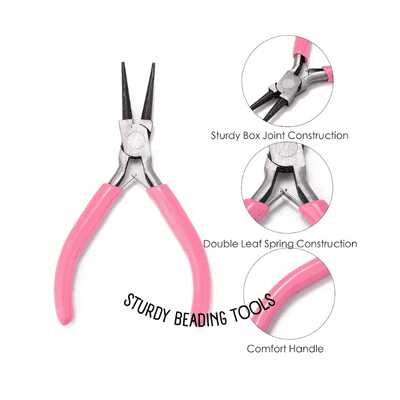
The most durable stringing material in the world will fail if the finishing is poor. With beading wire, this means using quality crimp beads (not crimp covers, which are decorative only) and proper crimping pliers. A flattened crimp made with round-nose pliers is weaker than one made with dedicated crimping pliers that fold the crimp into a rounded tube — the folded tube distributes tension far more evenly.
With knotted cord, it means learning to tie a consistent surgeon's knot and treating it with a small drop of jewellery adhesive before trimming the tail. With elastic, it means giving the cord a firm stretch before knotting — a bracelet strung on unstretched elastic will loosen significantly after the first few wearings and the knot will quickly pull through.
These finishing details are unglamorous, but they are the difference between a piece that a customer wears for years and recommends to others, and one that breaks on the way home from the market.
Still not sure which material is right for your project?
At Australia Beads, we have been helping makers find exactly the right supplies since 1998. If you have a specific project in mind and you're not sure which stringing material to use, feel free to reach out — we are happy to make a recommendation based on your beads, your design, and how the piece will be worn.